The Significance of the
Seven Ecumenical Councils
by Dr Mario Baghos
Lecturer in Patristics and Church History at St Andrew’s Greek Orthodox Theological College
Lecturer in Patristics and Church History at St Andrew’s Greek Orthodox Theological College
Variously interpreted as a violent revolutionary, a social activist, or not existing at all, our Lord Jesus Christ is often subjected to harsh misrepresentations in the public space and scholarly discourse that are either existentially damaging or have little or no value for either the believer or the non-believer. These misconstruals of the Lord are connected to general misrepresentations of God: the influence of Enlightenment Deism has been hard to shake, and it has resulted in an impersonal view of God that has nothing to do with the revelation given to the Church that God is personal; that he is three persons, Father, Son, and Holy Spirit, which is a reality and experience disclosed to us by the Son, our Lord Jesus, and the experience of the saints. This article is intended to remind us of the importance of the seven ecumenical councils of the Orthodox Church: for their doctrinal definitions concerning our Lord and Saviour are inspired by God himself and are consistent with the saints’ experience of him.
The First and Second Ecumenical Councils
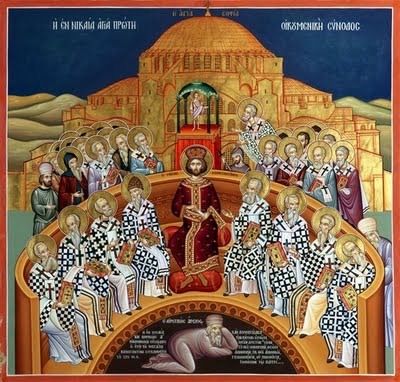
Our Lord Jesus Christ has deemed that we should know, inasmuch as humanly possible, the truth concerning our provident God for our salvation. Although the transcendent God is in his innermost being or essence inaccessible to us, in his relationship to the world he can be known—and is known and experienced—within the sacred body of his Son, the Church. That the Son of God, our Lord Jesus Christ, is also completely God—sharing in the same essence with the Father—is something that the Church has always experienced in the faith “once and for all delivered to the saints” (Jude 1:3). Historically, however, this faith had to be expounded, or clarified, in response to heretical notions that disparaged the Son’s divinity, that represented him as a creature and not fully God. Thus, when in the fourth century, the Roman Empire was ravaged by the teachings of Arius and his followers who claimed that the Son of God was a creature, not sharing in the divinity of his Father, the emperor St Constantine responded by convoking a council of the Church in the city of Nicaea in AD 325 to address this problem. This was known as the first ecumenical council, the word ‘ecumenical’ coming from the Greek word oikoumene (οἰκουμένη) which means civilisation and referred to the Roman Empire. It was the first major council of the Roman Empire which, since Constantine’s reign, began to work in collaboration with the Church, and although the emperor convoked the council it was a bishop of the church, St Ossius of Cordova, who presided. This set the precedent for all future councils.
At the first ecumenical council held in Nicaea, therefore, saints of the Church like Alexander and Athanasius of Alexandria—supported later by the Roman pope-saints Julius and Liberius—affirmed what the Church always held to be true: that the Son of God is “one essence with the Father,” homoousion to Patri (ὁμοούσιον τῷ Πατρί),[1] as enshrined in the creed that we recite every divine liturgy, which was given final form at the second ecumenical council held in AD 381 in the capital city of Constantinople during the reign of the emperor St Theodosius I. The second council, like the first, dealt with Arianism, reaffirmed the Nicene doctrine that Christ is “one essence” with the Father—fully divine and fully God—and also affirmed the divinity of the Holy Spirit against those who denied the Spirit’s divinity also.
One may consider why it is important for the Church to promulgate the truth concerning its experience of the Holy Trinity, of the Father, the Son and the Holy Spirit, as being fully God? It is because the heretical notions that rejected the divinity of the persons of the Trinity can compromise our participation in God. If Christ, the Son of God, is not fully divine and thus eternal—the way that his Father is divine and eternal—then how could he save us from mortality and the finitude of death? Only the eternal God can raise us—who are finite and mortal—up to eternal life, which our Lord Jesus accomplished when he defeated death through the cross and his resurrection. How can the Holy Spirit sanctify us if he is not fully God, to be worshipped equally with the Father and the Son? Of course, we do not believe in three Gods, but one God who is three persons, each one sharing the same divinity, the same Godhead; and this is the Christian God who has saved us from death.
The Third and Fourth Ecumenical Councils
Our God has saved us through the agency of the Son, who, while forever working together with the Father and the Spirit on account of their shared divine essence, activity and will, became one of us by assuming human nature in its totality, apart from sin. The Son did this while paradoxically remaining fully God, so that in Christ Jesus we contemplate the mystery of God becoming man while remaining God, the Godman or theanthropos (Θεάνθρωπος) as we call him. It of course follows that if the Son of God was born into this world as a man while remaining God, that his holy Mother, the Theotokos (Θεοτόκος) and ever-virgin Mary, gave birth to God in the flesh. But in the early fifth century this sacred truth that we revere was criticised by Nestorius, the bishop of Constantinople, who affirmed that the holy Virgin should not be called ‘Theotokos,’ which means God-bearer, that is, the one who gave birth to God, but ‘Christotokos,’ the one who gave birth to a mere man, Jesus Christ.
Nestorius was effectively denouncing the divinity of Christ when he said this, for to acclaim the Virgin as God-bearer or Theotokos is to acknowledge that she gave birth to God in the flesh for our salvation. But, strangely, Nestorius still believed in the divinity of the Son of God, just not that the Son of God was born of a woman. The outcome of his attempt to synthesise the man Christ, who he believed was born of the Virgin, and the Son or Logos of God who is the second person of the Holy Trinity, created a duality in his representation of Christ: for Nestorius affirmed that the man Jesus was at some point in his life assumed or adopted by the Son of God; that there were in other words two persons or prosopa (πρόσωπα) in Christ, two active subjects! This was of course antithetical to the Church’s experience, for, as St Cyril of Alexandria, who refuted Nestorius’ teaching on both the Virgin and Christ, declared: we know only one Lord and Saviour Jesus Christ; it is the one Christ that we worship, pray to, and participate in in the Eucharist.[2] This Christ is both divine and human, since he is the Son of God who became man while remaining God—but he is nevertheless ‘one’ person, the second person of the Holy Trinity.
In order to maintain the unity of Christ in opposition to Nestorius’ rendition of him as two—or even three persons (for he had said that when the man Jesus and the Son of God were combined, they created a new, third person)—St Cyril used various devices, including asserting that there is “one nature of [God] the Word incarnate” (mia fusis tou [Theou] Logou sesarkomeni/μία φύσις τοῦ [Θεού] Λόγου σεσαρκωμένη).[3] This statement would seem to imply that there is only one nature in Christ, which would be incorrect. But Cyril used the word φύσις, commonly translated as ‘nature,’ to designate ‘reality’ or ‘personhood,’ meaning that we can paraphrase his saying to denote that there is one reality or person of God the Word who became man as Christ Jesus. Another ecumenical council was held in Ephesus in 431, during the reign of the emperor St Theodosius II, that enshrined Cyril’s teaching and rejected the ideas of Nestorius.
But, after his repose in the Lord, Cyril was misinterpreted by his over-zealous followers (Eutyches and Dioscorus), who believed that the bishop, in his statement “one nature of the Word incarnate,” referred to the word nature or φύσις literally, so they concluded that if Christ only had one nature, that must be the divine one. These were described as monophysites (μονοφυσίτες), believing that Christ’s humanity was overshadowed or subsumed by his divinity. But their position was not acceptable to the Church. We said above that Christ is fully God because only the eternal God can save humans from death; but Christ, in order to save us from death, is also fully human, otherwise we cannot participate in the salvation he wrought in our behalf. A fourth council, held in Chalcedon in 451, clarified St Cyril’s teaching and, with additions made by the Tome of Pope Leo of Rome, developed the following definition of the faith:
So, following the saintly fathers, we all with one voice teach the confession of one and the same
Son, our Lord Jesus Christ: the same perfect in divinity and perfect in humanity, the same truly God
and truly man, of a rational soul and a body; consubstantial with the Father as regards his divinity,
and the same consubstantial with us as regards his humanity; like us in all respects except for sin;
begotten before the ages from the Father as regards his divinity, and in the last days the same for us
and for our salvation from Mary, the virgin God-bearer, as regards his humanity; one and the same
Christ, Son, Lord, only-begotten, acknowledged in two natures which undergo no confusion, no
change, no division, no separation; at no point was the difference between the natures taken away
from the union, but rather the property of both natures is preserved and comes together into a
single person and a single hypostasis; he is not parted or divided into two persons, but is one and
the same only-begotten Son, God, Word, Lord Jesus Christ, just as the prophets taught from the
beginning about him, and as the Lord Jesus Christ himself instructed us, and as the creed of the
fathers handed it down to us.[4]
As Orthodox Christians we believe therefore that there is one Christ in two natures, divine and human; he is fully God insofar as he is divine and has the power of God over life and death, and he became fully human that we might participate in the eternal life that only he can give.
The Fifth Ecumenical Council
The interim between the fourth and fifth ecumenical councils was a turbulent one. The council of 451 was by-and-large not accepted in the land where Cyril preached, and the disunity between what can be termed the ‘Chalcedonians’—that is, the Orthodox—and ‘non-Chalcedonians’—or monophysites—resulted in failed attempts by subsequent emperors to bypass or supersede the council. The polarity between the Chalcedonians and the non-Chalcedonians was expressed in the latter interpreting the definition of faith at Chalcedon that affirmed that Christ has two natures as ‘Nestorian,’ and the former in turn condemning monophysitism as contrary to Orthodox doctrine. In order to bring these groups into unity, in AD 553 the emperor St Justinian convoked in Constantinople a fifth ecumenical council that both confirmed the council of Chalcedon and attempted to placate the non-Chalcedonians by condemning certain persons and writings from the Antiochian tradition that they believed were associated with Nestorian teaching. These were Theodore of Mopsuestia and his works, select writings of Theodoret of Cyrrhus, and a letter of Ibas of Edessa to the Persian bishop, Maris. These were known as the Three Chapters. But in order not to alienate the Antiochians that could discern no Nestorianism in the writings of Theodore of Mopsuestia, Justinian also denounced Origen of Alexandria, who was considered by the Antiochians to be the source of monophysitism. Although the council was daring in its attempt at reunification, the mutual condemnations to placate factious elements did not succeeded in bringing the non-Chalcedonians into the fold. What this council did accomplish was to confirm and clarify the council of Chalcedon, interpreting it through the lens of St Cyril’s emphasis on Christ’s unity. This can be described as neo-Chalcedonianism. This emphasis on Christ’s oneness is exemplified in the hymn to the “Only begotten Son,” which we chant in every liturgy. This hymn maintains the Son of God’s divinity while affirming that he became human “without change,” to save us while remaining one of the Holy Trinity, “glorified together with the Father and the Holy Spirit.”[5]
The Sixth Ecumenical Council
Despite the fifth ecumenical council, the division between the non-Chalcedonians and neo-Chalcedonians continued to grow. The Persian advance into territories inhabited by the former threatened to separate the two even further. In the early 600s the patriarch of Constantinople, Sergius, had a plan for unification. He “built on the Cyrilline Chalcedonianism of Justinian [that] amounted to the affirmation of” Christ as “one divine person, possessing two natures, one divine, one human, both in their full integrity, with the further assertion that this single person was expressed in a single activity (or energy, in Greek: energeia): a doctrine called ‘Monoenergism’ [μονοενεργητισμός].”[6] Monoenergism was immediately promoted as achieving union between non-Chalcedonians and neo-Chalcedonians, but was rebuked by St Sophronius—who later became patriarch of Jerusalem—insofar as he perceived that it nullified the duality of Christ’s natures. In deference to Sophronius, Sergius composed his Psephos which emphasised Christ’s oneness but excluded “there being two wills in Christ contrary to each other,”[7] a position that was refined by Pope Honorius of Rome, who celebrated the ostensible restoration of the Church and confessed “the one will of our Lord Jesus Christ,”[8] so that monoenergism—the construal of Christ’s person as expressed through a single activity or energy—transformed into the doctrine of monothelitism [μονοθελητισμός], the belief that Christ has a single, divine will.
It was monothelitism, as a refinement of monoenergism, that was expounded by Sergius in his Ekthesis that became an imperial edict issued by the emperor Heraclius from the capital city of Constantinople in AD 638. St Sophronius argued against monothelitism as implying monophysitism; an overshadowing of Christ’s humanity in not accepting the existence of his human will. Not long after, St Maximus the Confessor refuted monothelitism, and Sergius’ Ekthesis was condemned by several councils in North Africa, prompting Heraclius’ successor, Constans II, to issue his Typos which forbade any discussion of wills or energies in Christ. Saint-pope Martin of Rome rebelled against this decree, holding the Lateran council of 649—to which St Maximus, who was present at the council, contributed greatly—to condemn the heresy of the imperial court. Both saints were arrested, terribly mistreated, and taken back to Constantinople for trial: the former died in Cherson, Crimea, in 655, and the latter in Tsageri, Georgia, in 662. Their views, that Christ has a fully divine will and a fully human one, were not vindicated until the sixth ecumenical council held in Constantinople almost twenty years later between 680 and 681. Convoked by emperor Constantine IV, the council condemned monoenergism and monothelitism and, following a reiteration of the definition of Chalcedon, affirmed that in Christ there are:
…two natural volitions or wills … and two natural principles of action which undergo no division, no
change, no partition, no confusion, in accordance with the teaching of the holy fathers. And the two
natural wills are not in opposition, as the impious heretics said, far from it, but his human will
following, and not resisting or struggling, rather in fact subject to his divine and all powerful will.[9]
Since the human will is so characteristic of human nature, then the Son of God, in his assumption of the human nature, also assumed a human will. So, while in Christ there are “two natural wills, because there are two natures”[10]—in other words, the divine will that he shares with the Father and the Holy Spirit and his human will—his assumption of the latter did not involve the adoption of the deliberative process that leads us to sin (what St Maximus the Confessor describes as the human being’s ‘gnomic’ will, as distinct from our natural will).[11]
The Seventh Ecumenical Council
The doctrinal definitions of ecumenical councils one through six, held throughout various cities in Byzantium, all concerned our Lord Jesus Christ, and asserted, in consecutive order, his divinity or shared essence with the Father (councils one and two), the oneness of his person (council three), the reality of his divine and human natures (council four), his oneness once again (council five), and the full integrity of his human nature by affirming that he had a human will which was subject to his divine one. Addressed in such a manner, the councils seem to reflect a progression into the mystery of the eternal Son of God’s divine economy, of his incarnation: begotten of the Father before all ages, he deigned to become one of us, a human being, while remaining fully God. The incarnation is perhaps best attested to in the iconographic tradition of the Orthodox Church: for the icons, made of material pigments, wood and other elements, are a testimony to the fact that the Son of God, in assuming human nature which is a microcosm, in fact sanctified all matter—cosmically—through his incarnation. We can therefore utilise matter in order to depict him; and we create and venerate the icons insofar as they authentically depict—and, by God’s grace—participate in their archetypes, whether in Christ or his saints.
In the early eighth century, the Islamic aversion to anthropomorphic imagery influenced the emperor Leo the Isaurian, who inherited an empire in decline at the former’s gain. Falsely interpreting the veneration of icons as bringing God’s displeasure, the emperor instigated an empire-wide destruction of sacred images, citing Old Testament precedents (i.e. the second commandment) as a justification. In reality, the veneration of icons was disliked because it drew attention away from the emperor and the imperial cult; iconoclasm was just a matter of consolidating imperial control of citizens, who, as the successive waves of iconoclasm buffeted the capital, displayed their love for their sacred images, many to the point of martyrdom. That icon veneration is not idolatry was made clear when the first major wave of iconoclasm was halted by the empress St Irene, who held the seventh ecumenical council in the city of Nicaea in AD 787. The doctrinal definition of that council affirmed:
…stepping out as though on the royal highway, following as we are the God-spoken teaching of our
holy fathers and the tradition of the catholic church—for we recognize that this tradition comes
from the Holy Spirit who dwells in her—we decree with full precision and care that, like the figure of
the honoured and life-giving cross, the reverend and holy images, whether painted or made of
mosaic or of other suitable material, are to be exposed in the holy churches of God, on sacred
instruments and vestments, on walls and panels, in houses and public ways; these are the images
of our Lord, God and saviour, Jesus Christ, and of our Lady without blemish, the holy God-bearer,
and of the revered angels and any of the saintly holy men. The more frequent they are seen in
representational art, the more are those who see them drawn to remember and long for those who
serve as models, and to pay these images the tribute of salutation and respectful veneration.
Certainly this is not the full adoration in accordance with our faith, which is properly paid only to
the divine nature, but it resembles that given to the figure of the honoured and life-giving cross,
and also to the holy books of the gospels and to other sacred cult objects. …Indeed, the honour paid
to the image traverses it, reaching the model; and he who venerates the image, venerates the
person represented in the image. [12]
While iconoclasm returned briefly, again for political reasons, in the ninth century—to be quashed by the empress St Theodora in a subsequent council in 843 (the ‘Triumph of Orthodoxy’)—the distinction between veneration and adoration or worship remained, and remains, important. As Orthodox Christians, we render worship to God alone, but we venerate the sacred icons because the veneration given to the image is transferred to the person represented in that image. Since the icons represent Christ, who is God, and the saints who are imbued with God’s grace, then the Lord himself is venerated in each and every icon we kiss and pay homage too; much like the sacred relics of the saints. The fact that the Lord and his saints (the latter by his grace) are at work through the icons is made clear by the countless testimonies of miraculous icons that have been (and are still) venerated throughout the Church’s history.
The Orthodox Church therefore preserves a consistent representation of our Lord Jesus Christ, revealed to us by the Lord himself, both in its doctrinal formulations and its images. This representation has salvific import since a proper understanding of who he is conditions our participation in him. That he is God means that he has all power over death, and that he is fully man (yet without sin) means that we can participate in his victory over death. That these representations, in letter and art, accord with the experience of the saints that have come to know Christ even in this life, is confirmed by the Church’s tradition, which acts as a corrective to the many false beliefs and construals of the Lord in the public domain.
[Originally published in two parts in The Greek Australian VEMA: September (2018): 13/29 and October (2018): 13/29]
[1] Other notable saints present at the council included St Nicholas of Myra, St Macarius of Jerusalem, and St Spyridon of Trymithous, to name a few.
[2] Decrees of the Ecumenical Councils, ed. Norman P. Tanner (Washington DC: Georgetown University Press, 1989), 51.
[3] Translated from St Cyril’s Second Letter to Succensus in PG 77, 241.
[4] Decrees of the Ecumenical Councils, 86.
[5] The Divine Liturgy of our Father among the Saints John Chrysostom (Sydney: St Andrew’s Orthodox Press, 2005), 15.
[6] Andrew Louth, Maximus the Confessor (London and New York: Routledge, 1996), 12.
[7] Ibid., 13.
[8] Ibid., 14.
[9] Decrees of the Ecumenical Councils, ed. Norman P. Tanner (Washington DC: Georgetown University Press, 1989), 128.
[10] Louth, Maximus the Confessor, 59.
[11] Ibid.
[12] Decrees of the Ecumenical Councils, 135-36.
The First and Second Ecumenical Councils
Our Lord Jesus Christ has deemed that we should know, inasmuch as humanly possible, the truth concerning our provident God for our salvation. Although the transcendent God is in his innermost being or essence inaccessible to us, in his relationship to the world he can be known—and is known and experienced—within the sacred body of his Son, the Church. That the Son of God, our Lord Jesus Christ, is also completely God—sharing in the same essence with the Father—is something that the Church has always experienced in the faith “once and for all delivered to the saints” (Jude 1:3). Historically, however, this faith had to be expounded, or clarified, in response to heretical notions that disparaged the Son’s divinity, that represented him as a creature and not fully God. Thus, when in the fourth century, the Roman Empire was ravaged by the teachings of Arius and his followers who claimed that the Son of God was a creature, not sharing in the divinity of his Father, the emperor St Constantine responded by convoking a council of the Church in the city of Nicaea in AD 325 to address this problem. This was known as the first ecumenical council, the word ‘ecumenical’ coming from the Greek word oikoumene (οἰκουμένη) which means civilisation and referred to the Roman Empire. It was the first major council of the Roman Empire which, since Constantine’s reign, began to work in collaboration with the Church, and although the emperor convoked the council it was a bishop of the church, St Ossius of Cordova, who presided. This set the precedent for all future councils.
At the first ecumenical council held in Nicaea, therefore, saints of the Church like Alexander and Athanasius of Alexandria—supported later by the Roman pope-saints Julius and Liberius—affirmed what the Church always held to be true: that the Son of God is “one essence with the Father,” homoousion to Patri (ὁμοούσιον τῷ Πατρί),[1] as enshrined in the creed that we recite every divine liturgy, which was given final form at the second ecumenical council held in AD 381 in the capital city of Constantinople during the reign of the emperor St Theodosius I. The second council, like the first, dealt with Arianism, reaffirmed the Nicene doctrine that Christ is “one essence” with the Father—fully divine and fully God—and also affirmed the divinity of the Holy Spirit against those who denied the Spirit’s divinity also.
One may consider why it is important for the Church to promulgate the truth concerning its experience of the Holy Trinity, of the Father, the Son and the Holy Spirit, as being fully God? It is because the heretical notions that rejected the divinity of the persons of the Trinity can compromise our participation in God. If Christ, the Son of God, is not fully divine and thus eternal—the way that his Father is divine and eternal—then how could he save us from mortality and the finitude of death? Only the eternal God can raise us—who are finite and mortal—up to eternal life, which our Lord Jesus accomplished when he defeated death through the cross and his resurrection. How can the Holy Spirit sanctify us if he is not fully God, to be worshipped equally with the Father and the Son? Of course, we do not believe in three Gods, but one God who is three persons, each one sharing the same divinity, the same Godhead; and this is the Christian God who has saved us from death.
The Third and Fourth Ecumenical Councils
Our God has saved us through the agency of the Son, who, while forever working together with the Father and the Spirit on account of their shared divine essence, activity and will, became one of us by assuming human nature in its totality, apart from sin. The Son did this while paradoxically remaining fully God, so that in Christ Jesus we contemplate the mystery of God becoming man while remaining God, the Godman or theanthropos (Θεάνθρωπος) as we call him. It of course follows that if the Son of God was born into this world as a man while remaining God, that his holy Mother, the Theotokos (Θεοτόκος) and ever-virgin Mary, gave birth to God in the flesh. But in the early fifth century this sacred truth that we revere was criticised by Nestorius, the bishop of Constantinople, who affirmed that the holy Virgin should not be called ‘Theotokos,’ which means God-bearer, that is, the one who gave birth to God, but ‘Christotokos,’ the one who gave birth to a mere man, Jesus Christ.
Nestorius was effectively denouncing the divinity of Christ when he said this, for to acclaim the Virgin as God-bearer or Theotokos is to acknowledge that she gave birth to God in the flesh for our salvation. But, strangely, Nestorius still believed in the divinity of the Son of God, just not that the Son of God was born of a woman. The outcome of his attempt to synthesise the man Christ, who he believed was born of the Virgin, and the Son or Logos of God who is the second person of the Holy Trinity, created a duality in his representation of Christ: for Nestorius affirmed that the man Jesus was at some point in his life assumed or adopted by the Son of God; that there were in other words two persons or prosopa (πρόσωπα) in Christ, two active subjects! This was of course antithetical to the Church’s experience, for, as St Cyril of Alexandria, who refuted Nestorius’ teaching on both the Virgin and Christ, declared: we know only one Lord and Saviour Jesus Christ; it is the one Christ that we worship, pray to, and participate in in the Eucharist.[2] This Christ is both divine and human, since he is the Son of God who became man while remaining God—but he is nevertheless ‘one’ person, the second person of the Holy Trinity.
In order to maintain the unity of Christ in opposition to Nestorius’ rendition of him as two—or even three persons (for he had said that when the man Jesus and the Son of God were combined, they created a new, third person)—St Cyril used various devices, including asserting that there is “one nature of [God] the Word incarnate” (mia fusis tou [Theou] Logou sesarkomeni/μία φύσις τοῦ [Θεού] Λόγου σεσαρκωμένη).[3] This statement would seem to imply that there is only one nature in Christ, which would be incorrect. But Cyril used the word φύσις, commonly translated as ‘nature,’ to designate ‘reality’ or ‘personhood,’ meaning that we can paraphrase his saying to denote that there is one reality or person of God the Word who became man as Christ Jesus. Another ecumenical council was held in Ephesus in 431, during the reign of the emperor St Theodosius II, that enshrined Cyril’s teaching and rejected the ideas of Nestorius.
But, after his repose in the Lord, Cyril was misinterpreted by his over-zealous followers (Eutyches and Dioscorus), who believed that the bishop, in his statement “one nature of the Word incarnate,” referred to the word nature or φύσις literally, so they concluded that if Christ only had one nature, that must be the divine one. These were described as monophysites (μονοφυσίτες), believing that Christ’s humanity was overshadowed or subsumed by his divinity. But their position was not acceptable to the Church. We said above that Christ is fully God because only the eternal God can save humans from death; but Christ, in order to save us from death, is also fully human, otherwise we cannot participate in the salvation he wrought in our behalf. A fourth council, held in Chalcedon in 451, clarified St Cyril’s teaching and, with additions made by the Tome of Pope Leo of Rome, developed the following definition of the faith:
So, following the saintly fathers, we all with one voice teach the confession of one and the same
Son, our Lord Jesus Christ: the same perfect in divinity and perfect in humanity, the same truly God
and truly man, of a rational soul and a body; consubstantial with the Father as regards his divinity,
and the same consubstantial with us as regards his humanity; like us in all respects except for sin;
begotten before the ages from the Father as regards his divinity, and in the last days the same for us
and for our salvation from Mary, the virgin God-bearer, as regards his humanity; one and the same
Christ, Son, Lord, only-begotten, acknowledged in two natures which undergo no confusion, no
change, no division, no separation; at no point was the difference between the natures taken away
from the union, but rather the property of both natures is preserved and comes together into a
single person and a single hypostasis; he is not parted or divided into two persons, but is one and
the same only-begotten Son, God, Word, Lord Jesus Christ, just as the prophets taught from the
beginning about him, and as the Lord Jesus Christ himself instructed us, and as the creed of the
fathers handed it down to us.[4]
As Orthodox Christians we believe therefore that there is one Christ in two natures, divine and human; he is fully God insofar as he is divine and has the power of God over life and death, and he became fully human that we might participate in the eternal life that only he can give.
The Fifth Ecumenical Council
The interim between the fourth and fifth ecumenical councils was a turbulent one. The council of 451 was by-and-large not accepted in the land where Cyril preached, and the disunity between what can be termed the ‘Chalcedonians’—that is, the Orthodox—and ‘non-Chalcedonians’—or monophysites—resulted in failed attempts by subsequent emperors to bypass or supersede the council. The polarity between the Chalcedonians and the non-Chalcedonians was expressed in the latter interpreting the definition of faith at Chalcedon that affirmed that Christ has two natures as ‘Nestorian,’ and the former in turn condemning monophysitism as contrary to Orthodox doctrine. In order to bring these groups into unity, in AD 553 the emperor St Justinian convoked in Constantinople a fifth ecumenical council that both confirmed the council of Chalcedon and attempted to placate the non-Chalcedonians by condemning certain persons and writings from the Antiochian tradition that they believed were associated with Nestorian teaching. These were Theodore of Mopsuestia and his works, select writings of Theodoret of Cyrrhus, and a letter of Ibas of Edessa to the Persian bishop, Maris. These were known as the Three Chapters. But in order not to alienate the Antiochians that could discern no Nestorianism in the writings of Theodore of Mopsuestia, Justinian also denounced Origen of Alexandria, who was considered by the Antiochians to be the source of monophysitism. Although the council was daring in its attempt at reunification, the mutual condemnations to placate factious elements did not succeeded in bringing the non-Chalcedonians into the fold. What this council did accomplish was to confirm and clarify the council of Chalcedon, interpreting it through the lens of St Cyril’s emphasis on Christ’s unity. This can be described as neo-Chalcedonianism. This emphasis on Christ’s oneness is exemplified in the hymn to the “Only begotten Son,” which we chant in every liturgy. This hymn maintains the Son of God’s divinity while affirming that he became human “without change,” to save us while remaining one of the Holy Trinity, “glorified together with the Father and the Holy Spirit.”[5]
The Sixth Ecumenical Council
Despite the fifth ecumenical council, the division between the non-Chalcedonians and neo-Chalcedonians continued to grow. The Persian advance into territories inhabited by the former threatened to separate the two even further. In the early 600s the patriarch of Constantinople, Sergius, had a plan for unification. He “built on the Cyrilline Chalcedonianism of Justinian [that] amounted to the affirmation of” Christ as “one divine person, possessing two natures, one divine, one human, both in their full integrity, with the further assertion that this single person was expressed in a single activity (or energy, in Greek: energeia): a doctrine called ‘Monoenergism’ [μονοενεργητισμός].”[6] Monoenergism was immediately promoted as achieving union between non-Chalcedonians and neo-Chalcedonians, but was rebuked by St Sophronius—who later became patriarch of Jerusalem—insofar as he perceived that it nullified the duality of Christ’s natures. In deference to Sophronius, Sergius composed his Psephos which emphasised Christ’s oneness but excluded “there being two wills in Christ contrary to each other,”[7] a position that was refined by Pope Honorius of Rome, who celebrated the ostensible restoration of the Church and confessed “the one will of our Lord Jesus Christ,”[8] so that monoenergism—the construal of Christ’s person as expressed through a single activity or energy—transformed into the doctrine of monothelitism [μονοθελητισμός], the belief that Christ has a single, divine will.
It was monothelitism, as a refinement of monoenergism, that was expounded by Sergius in his Ekthesis that became an imperial edict issued by the emperor Heraclius from the capital city of Constantinople in AD 638. St Sophronius argued against monothelitism as implying monophysitism; an overshadowing of Christ’s humanity in not accepting the existence of his human will. Not long after, St Maximus the Confessor refuted monothelitism, and Sergius’ Ekthesis was condemned by several councils in North Africa, prompting Heraclius’ successor, Constans II, to issue his Typos which forbade any discussion of wills or energies in Christ. Saint-pope Martin of Rome rebelled against this decree, holding the Lateran council of 649—to which St Maximus, who was present at the council, contributed greatly—to condemn the heresy of the imperial court. Both saints were arrested, terribly mistreated, and taken back to Constantinople for trial: the former died in Cherson, Crimea, in 655, and the latter in Tsageri, Georgia, in 662. Their views, that Christ has a fully divine will and a fully human one, were not vindicated until the sixth ecumenical council held in Constantinople almost twenty years later between 680 and 681. Convoked by emperor Constantine IV, the council condemned monoenergism and monothelitism and, following a reiteration of the definition of Chalcedon, affirmed that in Christ there are:
…two natural volitions or wills … and two natural principles of action which undergo no division, no
change, no partition, no confusion, in accordance with the teaching of the holy fathers. And the two
natural wills are not in opposition, as the impious heretics said, far from it, but his human will
following, and not resisting or struggling, rather in fact subject to his divine and all powerful will.[9]
Since the human will is so characteristic of human nature, then the Son of God, in his assumption of the human nature, also assumed a human will. So, while in Christ there are “two natural wills, because there are two natures”[10]—in other words, the divine will that he shares with the Father and the Holy Spirit and his human will—his assumption of the latter did not involve the adoption of the deliberative process that leads us to sin (what St Maximus the Confessor describes as the human being’s ‘gnomic’ will, as distinct from our natural will).[11]
The Seventh Ecumenical Council
The doctrinal definitions of ecumenical councils one through six, held throughout various cities in Byzantium, all concerned our Lord Jesus Christ, and asserted, in consecutive order, his divinity or shared essence with the Father (councils one and two), the oneness of his person (council three), the reality of his divine and human natures (council four), his oneness once again (council five), and the full integrity of his human nature by affirming that he had a human will which was subject to his divine one. Addressed in such a manner, the councils seem to reflect a progression into the mystery of the eternal Son of God’s divine economy, of his incarnation: begotten of the Father before all ages, he deigned to become one of us, a human being, while remaining fully God. The incarnation is perhaps best attested to in the iconographic tradition of the Orthodox Church: for the icons, made of material pigments, wood and other elements, are a testimony to the fact that the Son of God, in assuming human nature which is a microcosm, in fact sanctified all matter—cosmically—through his incarnation. We can therefore utilise matter in order to depict him; and we create and venerate the icons insofar as they authentically depict—and, by God’s grace—participate in their archetypes, whether in Christ or his saints.
In the early eighth century, the Islamic aversion to anthropomorphic imagery influenced the emperor Leo the Isaurian, who inherited an empire in decline at the former’s gain. Falsely interpreting the veneration of icons as bringing God’s displeasure, the emperor instigated an empire-wide destruction of sacred images, citing Old Testament precedents (i.e. the second commandment) as a justification. In reality, the veneration of icons was disliked because it drew attention away from the emperor and the imperial cult; iconoclasm was just a matter of consolidating imperial control of citizens, who, as the successive waves of iconoclasm buffeted the capital, displayed their love for their sacred images, many to the point of martyrdom. That icon veneration is not idolatry was made clear when the first major wave of iconoclasm was halted by the empress St Irene, who held the seventh ecumenical council in the city of Nicaea in AD 787. The doctrinal definition of that council affirmed:
…stepping out as though on the royal highway, following as we are the God-spoken teaching of our
holy fathers and the tradition of the catholic church—for we recognize that this tradition comes
from the Holy Spirit who dwells in her—we decree with full precision and care that, like the figure of
the honoured and life-giving cross, the reverend and holy images, whether painted or made of
mosaic or of other suitable material, are to be exposed in the holy churches of God, on sacred
instruments and vestments, on walls and panels, in houses and public ways; these are the images
of our Lord, God and saviour, Jesus Christ, and of our Lady without blemish, the holy God-bearer,
and of the revered angels and any of the saintly holy men. The more frequent they are seen in
representational art, the more are those who see them drawn to remember and long for those who
serve as models, and to pay these images the tribute of salutation and respectful veneration.
Certainly this is not the full adoration in accordance with our faith, which is properly paid only to
the divine nature, but it resembles that given to the figure of the honoured and life-giving cross,
and also to the holy books of the gospels and to other sacred cult objects. …Indeed, the honour paid
to the image traverses it, reaching the model; and he who venerates the image, venerates the
person represented in the image. [12]
While iconoclasm returned briefly, again for political reasons, in the ninth century—to be quashed by the empress St Theodora in a subsequent council in 843 (the ‘Triumph of Orthodoxy’)—the distinction between veneration and adoration or worship remained, and remains, important. As Orthodox Christians, we render worship to God alone, but we venerate the sacred icons because the veneration given to the image is transferred to the person represented in that image. Since the icons represent Christ, who is God, and the saints who are imbued with God’s grace, then the Lord himself is venerated in each and every icon we kiss and pay homage too; much like the sacred relics of the saints. The fact that the Lord and his saints (the latter by his grace) are at work through the icons is made clear by the countless testimonies of miraculous icons that have been (and are still) venerated throughout the Church’s history.
The Orthodox Church therefore preserves a consistent representation of our Lord Jesus Christ, revealed to us by the Lord himself, both in its doctrinal formulations and its images. This representation has salvific import since a proper understanding of who he is conditions our participation in him. That he is God means that he has all power over death, and that he is fully man (yet without sin) means that we can participate in his victory over death. That these representations, in letter and art, accord with the experience of the saints that have come to know Christ even in this life, is confirmed by the Church’s tradition, which acts as a corrective to the many false beliefs and construals of the Lord in the public domain.
[Originally published in two parts in The Greek Australian VEMA: September (2018): 13/29 and October (2018): 13/29]
[1] Other notable saints present at the council included St Nicholas of Myra, St Macarius of Jerusalem, and St Spyridon of Trymithous, to name a few.
[2] Decrees of the Ecumenical Councils, ed. Norman P. Tanner (Washington DC: Georgetown University Press, 1989), 51.
[3] Translated from St Cyril’s Second Letter to Succensus in PG 77, 241.
[4] Decrees of the Ecumenical Councils, 86.
[5] The Divine Liturgy of our Father among the Saints John Chrysostom (Sydney: St Andrew’s Orthodox Press, 2005), 15.
[6] Andrew Louth, Maximus the Confessor (London and New York: Routledge, 1996), 12.
[7] Ibid., 13.
[8] Ibid., 14.
[9] Decrees of the Ecumenical Councils, ed. Norman P. Tanner (Washington DC: Georgetown University Press, 1989), 128.
[10] Louth, Maximus the Confessor, 59.
[11] Ibid.
[12] Decrees of the Ecumenical Councils, 135-36.