The Sacrament of Marriage
Part One
by Dr Philip Kariatlis
Sub-Dean and Associate Professor of Theology at St Andrew's Theological College
Sub-Dean and Associate Professor of Theology at St Andrew's Theological College
In the Eastern Orthodox tradition, marriage is first and foremost considered a sacrament of the Church. It is regarded so, because through marriage, it is believed, God opens up a pathway for two specific persons - husband and wife - to enter into his eternal kingdom. More so, as a sacrament of the Church, marriage is not only regarded as a sign of God’s kingdom - or a pathway towards it - but more than that, the very revelation of God’s heavenly kingdom in the world, a theophany in the real sense of the word. Indeed, in the New Testament, the marriage feast and the coming Kingdom of God are juxtaposed: "the kingdom of heaven may be compared to the wedding banquet" (Mt 22:2), namely, an understanding of marriage which is nothing less than a couple’s entrance into the realm of the miraculous and not the mundane. A couple - man and woman - entering into the sacrament of marriage is bestowed with the gifts of the Holy Spirit to embark upon a common life together towards God’s glorious kingdom, experiencing its first fruits even in the here and now, and then giving witness to this loving mode of communal existence to those around them. In this sense, when approached from the perspective of sacrament, marriage signifies something infinitely more that the mere cohabitation of two people for their own individual fulfilment or gratification. Indeed, as will be shown, when blessed by the Church, the natural bond has the potential of becoming an eternal one reflecting the loving fellowship of the divine Persons of the Holy Trinity.
It is this sacramental dimension of marriage which distinguishes the Eastern Orthodox vision of marriage from all other understandings. Understood in terms of a commitment between a husband and wife - which has been blessed at the same time with the gift the Holy Spirit - marriage is a holy vocation drawing husband and wife closer to one another as they journey together towards the liberating gift of God’s eternal kingdom. Accordingly, marriage cannot be seen merely as a human or legally binding institution which holds only to the extent that there is personal and interpersonal fulfilment. Furthermore, as “a sacrament of the kingdom,” this marital bond cannot therefore be reduced simply to a sanctioned means for procreation since its primary purpose is for husband and wife to assist each other towards the attainment of God’s kingdom in their life-long dedication and love for one another. In 1 Jn 3:14 we are assured that: "We know that we have passed from death to life because we love.” Moreover, as a sacrament of love, marriage has the potential of bringing a couple nearer to God. In reflecting on married life as a means for a couple’s encounter with God, St Gregory the Theologian wrote: “for marriage does not remove us from God, God brings us all the more closer to him, for it is God himself who draws us to it.”[1] According to St Gregory, within the context of marriage, it could very simply be put in the following way: “I love God by loving my spouse.” In this way, God becomes known - and indeed encountered - through the other. In uniting with God’s love in their love for one another, the couple is given the opportunity to become ‘god-like’ - namely, by grace, enabled to experience in this life, by way of foretaste, the life-giving fellowship and unitive love existing between Father, Son and Holy Spirit. It is in this sense that many Orthodox theologians have referred to the love experienced within the sacrament of marriage as something no less than a reflection of divine love, and therefore salvific.
Seen from within this salvific perspective, marriage ought not to be seen as being a restriction or loss of freedom as is often stated rather flippantly, but rather a unique potential for a couple, through the “sending down… of love perfect” - as is said in the marriage service - to unite themselves to God who himself is love (cf. 1 Jn 4:8) in their love for one another and in so doing to experience the freedom that God is (2 Cor 3:17). Indeed, with the gift of God’s liberating love, a couple is enabled to be freed from the constraints of isolationist and individualist tendencies - prominent characteristics of many ‘developed’ societies today - which lead to nothing other than a miserable existence, loneliness and ultimately death. Accordingly, the sacramental dimension of marriage signifies the Church’s understanding that marriage is an essential way of salvation, a consecration of two people equipped with the love of God so that, in freely striving together throughout life, they may make the eternal and liberating joy of God’s loving and communal mode of existence - and indeed his kingdom - a living presence in their life.
[1] St Gregory the Theologian, Poem in Praise of Virginity, cited in Glory and Honor: Orthodox Christian Resources on Marriage, ed. David C. Ford, Mary S. Ford and Alfred Kentigern Siewers (Yonkers NY: St Vladimir’s Seminary Press, 2016), 30.
It is this sacramental dimension of marriage which distinguishes the Eastern Orthodox vision of marriage from all other understandings. Understood in terms of a commitment between a husband and wife - which has been blessed at the same time with the gift the Holy Spirit - marriage is a holy vocation drawing husband and wife closer to one another as they journey together towards the liberating gift of God’s eternal kingdom. Accordingly, marriage cannot be seen merely as a human or legally binding institution which holds only to the extent that there is personal and interpersonal fulfilment. Furthermore, as “a sacrament of the kingdom,” this marital bond cannot therefore be reduced simply to a sanctioned means for procreation since its primary purpose is for husband and wife to assist each other towards the attainment of God’s kingdom in their life-long dedication and love for one another. In 1 Jn 3:14 we are assured that: "We know that we have passed from death to life because we love.” Moreover, as a sacrament of love, marriage has the potential of bringing a couple nearer to God. In reflecting on married life as a means for a couple’s encounter with God, St Gregory the Theologian wrote: “for marriage does not remove us from God, God brings us all the more closer to him, for it is God himself who draws us to it.”[1] According to St Gregory, within the context of marriage, it could very simply be put in the following way: “I love God by loving my spouse.” In this way, God becomes known - and indeed encountered - through the other. In uniting with God’s love in their love for one another, the couple is given the opportunity to become ‘god-like’ - namely, by grace, enabled to experience in this life, by way of foretaste, the life-giving fellowship and unitive love existing between Father, Son and Holy Spirit. It is in this sense that many Orthodox theologians have referred to the love experienced within the sacrament of marriage as something no less than a reflection of divine love, and therefore salvific.
Seen from within this salvific perspective, marriage ought not to be seen as being a restriction or loss of freedom as is often stated rather flippantly, but rather a unique potential for a couple, through the “sending down… of love perfect” - as is said in the marriage service - to unite themselves to God who himself is love (cf. 1 Jn 4:8) in their love for one another and in so doing to experience the freedom that God is (2 Cor 3:17). Indeed, with the gift of God’s liberating love, a couple is enabled to be freed from the constraints of isolationist and individualist tendencies - prominent characteristics of many ‘developed’ societies today - which lead to nothing other than a miserable existence, loneliness and ultimately death. Accordingly, the sacramental dimension of marriage signifies the Church’s understanding that marriage is an essential way of salvation, a consecration of two people equipped with the love of God so that, in freely striving together throughout life, they may make the eternal and liberating joy of God’s loving and communal mode of existence - and indeed his kingdom - a living presence in their life.
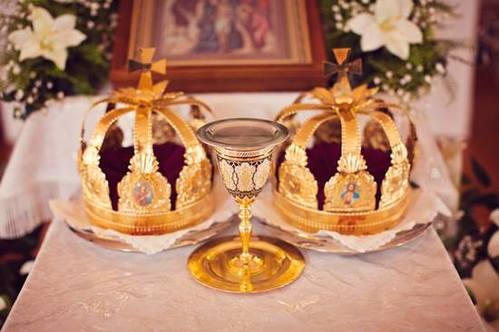
Understood as a divine gift or sacrament drawing a couple to one another, to God and his kingdom, the otherwise natural bond - between two people freely and willingly coming together - is sanctified and uplifted. This richer and deeper dimension of marriage is clearly seen in the Orthodox marriage service. The Church blesses, for example, the commitment of the couple to stay and travel together in life by crowning them with “glory and honour.” During the marriage service, the following hymn is sung three times: “O Lord our God, crown them with glory and honour [Κύριε ὁ Θεός ἡμῶν δόξῃ καί τιμῄ στεφάνωσον αὐτούς].” The action of crowning implies the conferral of royal status upon the couple. In a real sense, therefore, the Church celebrates God’s joining of two people to each other as ‘king’ and ‘queen’ of their own kingdom - a household church [κατ᾽ οἶκον … ἐκκλησίαν] (Rom 16:5) - and therefore a way towards God’s kingdom. To the extent that the Church, doctrinally speaking, is the miraculous presence of God within the world - God’s fellowship with the world - this implies that, for the couple, their gift of God's presence becomes tangibly actualised within their marital relationship since it is to the Church that they have come to be blessed for this journey together. The ‘gift’ of crowns, however, bestowed upon the couple at the beginning of their journey is at the same time a ‘task’ - namely, a call to the couple to become a ‘united kingdom’, namely a striving to nurture their unity, on a daily basis, throughout the many challenges that life will pose, so that in their end, when all words have been spoken, the couple may stand together present and ready for eternity, for God’s eternal kingdom. It is for this reason that the priest says: “Receive their crowns into your kingdom [ἀνάλαβε τούς στεφάνους αὐτῶν ἐν τῇ βασιλείᾳ σου].” Marriage, therefore, understood as a sacrament, is a gift and calling at the same time, for a couple, in their unitive love for one another, to work hard with God’s grace, so as to anticipate, in their life together, God’s future kingdom for them.
[1] St Gregory the Theologian, Poem in Praise of Virginity, cited in Glory and Honor: Orthodox Christian Resources on Marriage, ed. David C. Ford, Mary S. Ford and Alfred Kentigern Siewers (Yonkers NY: St Vladimir’s Seminary Press, 2016), 30.