Eternal Character of Marriage
Part three
by Dr Philip Kariatlis
Sub-Dean and Associate Professor of Theology at St Andrew's Theological College
Sub-Dean and Associate Professor of Theology at St Andrew's Theological College
Within the context of marriage, the natural bond between the couple is thereby given new impetus by which it is enabled, by Christ’s presence, to be transformed into an eternal one. Indeed, it is within the context of Christ’s ongoing presence within marriage that makes the bond of marriage such that it will even endure beyond death. On this, Fr Meyendorff has explicitly has written:
In light of a common misconception regarding the dissolution of marriage at the death of one of the spouses, it is important to highlight that, as a sacrament of the church, whose purpose is God’s kingdom, marriage within the Eastern Orthodox tradition, is understood to be an eternal reality. This understanding of marriage is clearly evident not only in the marriage service but also in the Patristic tradition. And so for example, the first prayer of the marriage service reads:
The blessings of God are extended not only to the couple, but also to any future children that may eventuate from the marriage. Still further, the gift of God’s ‘unfading’ or eternal crown of glory - namely his heavenly kingdom - is promised to the couple. It becomes clear, therefore that, as a sacrament of the Church - that is, as God’s gift to the couple of their presence within his kingdom - marriage primarily serves as the means by which God has given two people to be able to enter into his eternal kingdom as a couple beyond their biological death. In reflecting upon marriage in a commentary on St Paul’s letter to the Ephesians, St John Chrysostom affirms the eternality of marriage in a beautiful passage where he imagines what a newly married husband might be saying to his bride:
Indeed, it could further be said that, having as its purpose God’s future kingdom, it is there that the marital bond between husband and wife has the potential of being transformed and fulfilled beyond a mere natural one but rather into an eternal one, the fulfilment of which will continue in the age to come.
[1] John Meyendorff, Marriage: An Orthodox Perspective, 57.
[2] St John Chrysostom, Homily 20 on Ephesians, PG 62:146D-147A.
The peculiarity of Christian marriage consists in transforming and transfiguring a natural human affection between a man and woman into an eternal bond of love which cannot be broken even by death.[1]
In light of a common misconception regarding the dissolution of marriage at the death of one of the spouses, it is important to highlight that, as a sacrament of the church, whose purpose is God’s kingdom, marriage within the Eastern Orthodox tradition, is understood to be an eternal reality. This understanding of marriage is clearly evident not only in the marriage service but also in the Patristic tradition. And so for example, the first prayer of the marriage service reads:
Bless this marriage, and grant to these your servant (name) and (name) a peaceful life, length of days, moderation, love towards each other in the bond of peace, long-lived offspring, grace upon their children and the unfading crown of glory [δός αὐτοῖς ἀπό τῆς δρόσου τοῦ οὐρανοῦ].”
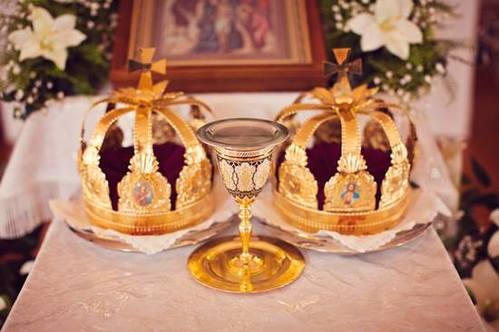
The blessings of God are extended not only to the couple, but also to any future children that may eventuate from the marriage. Still further, the gift of God’s ‘unfading’ or eternal crown of glory - namely his heavenly kingdom - is promised to the couple. It becomes clear, therefore that, as a sacrament of the Church - that is, as God’s gift to the couple of their presence within his kingdom - marriage primarily serves as the means by which God has given two people to be able to enter into his eternal kingdom as a couple beyond their biological death. In reflecting upon marriage in a commentary on St Paul’s letter to the Ephesians, St John Chrysostom affirms the eternality of marriage in a beautiful passage where he imagines what a newly married husband might be saying to his bride:
I fell in love with the excellence of your soul, which I value above all gold. For a young woman who is discreet and ingenuous, and whose heart is set on piety, is worth the whole world. For these reasons, then, I courted you, and I love you, and prefer you to my own soul… And I pray, and beseech, and do all I can, that we may be counted worthy to so live this present life, that we may be able also there in the world to come to be united to one another with great security. For our time here is brief and fleeting. But if we shall be counted worthy by having pleased God to exchange this life for that one, then shall we ever be both with Christ and with each other, with more abundant pleasure [πλείονος τῆς ἡδονῆς].[2]
Indeed, it could further be said that, having as its purpose God’s future kingdom, it is there that the marital bond between husband and wife has the potential of being transformed and fulfilled beyond a mere natural one but rather into an eternal one, the fulfilment of which will continue in the age to come.
[1] John Meyendorff, Marriage: An Orthodox Perspective, 57.
[2] St John Chrysostom, Homily 20 on Ephesians, PG 62:146D-147A.