THE GIFT OF TEARS
Part Nine, 9 April 2012
Philokalia: Love of Beauty & Goodness
Series by Fr Gerasimos Koutsouras
St George Church, Rose Bay Sermons
Philokalia: Love of Beauty & Goodness
Series by Fr Gerasimos Koutsouras
St George Church, Rose Bay Sermons
Brothers and sisters, last week we spoke about climbing the ladder of divine ascent. Step number seven on that ladder, referred to a peculiar concept, charopoion penthos, joy creating sorrow. What a strange idea. How can sorrow create joy? How can sorrow even be coupled with joy in the first place? And yet, this idea of charmolype is quite prevalent in the Eastern Christian Tradition and needs to be understood very well in order to understand such spiritual writngs as are to be found in the Philokalia. A couple of years ago, I gave a sermon likening charmolype to the season of Autumn. Together with the withering of nature, we get a sense of mild change, we get beautiful colours, ambers, yellows, reds, and purples. The Greek word for autumn, phthinoporo, refers to the ripening of fruit. And so, ripening has to do with maturity, has to do with wisdom, has to do with depth of spirit. Charmolype is a true mark of a spiritual person.
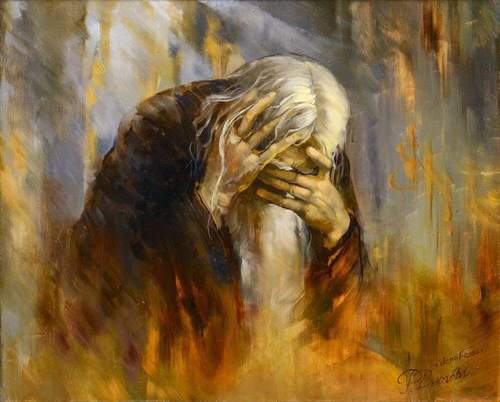
Which brings us to tears. When we are sad, we cry, we shed tears. Think about it for a moment. From a purely biological point of view, the practical purpose of tears is to expel any foreign bodies from our eyes. When a speck of dust goes into our eyes, the reflex is to produce tears, to wash away the dirt. And yet, when we are sad, there is no dust in our eyes. Why do we produce tears when we are sad? Tears are a truly amazing psychosomatic phenomenon... where the state of our soul (psyche) is reflected in the functions of our body (soma). As such, we Christians believe that tears, are a special gift, given to us by the Creator.
And yet, we moderns do not appreciate this gift. We’ve been around only since “yesterday” and we see no good in tears, we do not want tears, we are afraid to be sad, sad is bad, tears are for weaklings. Some of us have not shed a tear in years. Some of us have not shed a tear in decades. And that... is scary. There are only two possible reasons - either we have such a happy life that does not warrant any tears; or plain and simple, and we don’t even realise it... we have become hard-hearted, cold, and insensitive.
St John Chrysostomos describes what a great blessing of transformation the soul receives through the gift of tears:
Just as clouds when they gather, begin by making the day dark, then, once they have poured out all the water they contained, the atmosphere is serene and light; so, anguish, as it builds up in our heart, plunges our thoughts into darkness, but then, when it has vented all its bitterness through prayer and tears, it brings to the soul a great light. God’s influence irradiates the soul of the one who is praying, like a ray of sunlight.
The Book of Psalms says: “Weeping may endure for a night, but joy comes in the morning.” (Psalms 30:5). Το εσπερας αυλισθησεται κλαυθμος και εις το πρωι αγαλλιασις.
The Lord Jesus himself said the beautiful phrase: “Blessed are those who weep now, for you shall laugh... in the kingdom of heaven.” (Luke 6:21) Μακάριοι οι κλαίοντες νυν, ότι γελάσετε.
St Photios speaks of the fountain of tears. That most excellent and most beneficial blessing which drips down the cheeks, yet washing splendidly the soul... and waters the garden of our souls to bear fruits for us. St John Chrysostomos portrays an image of a fire being extinguished: “The fire of sin is intense, but it is put out by a small amount of tears, for the tear [to dakryon] puts out a furnace of faults, and cleans our souls from sin.” In describing the repentance of King David, St Chrysostomos describes those tears as pearls decorating the bed of the king.
If we have a closer look at the Bible, we will see that tears in the eyes were the prelude to intense contact with God. St Mary Magdalene was asked: “Why are you crying? Τι κλαιεις” before she recognised the resurrected Christ. The harlot, repenting from her ways, goes to Jesus and even washes his feet with her tears! Peter, after denying Jesus three times, wept bitterly. This cleansed him from the wrong he did, for Jesus commissioned him to tend to his flock. The king Hezekiah, weeping on his death-bed was given fifteen years more life. One of the hymns we chant during Lent lists examples of people saved through the tears of repentance and expresses our desire that we too may be saved through the transformation of our life:
“Παντοκρατωρ Κυριε, οιδα ποσα δυνανται τα δακρυα... ” “Almighty Lord, I know what tears are able to do... ”
The Lord Jesus himself, sanctified tears. The gospels record three instances where He wept. Once when his friend Lazarus died, once when he saw the unbelief of Jerusalem, and when he wept in the garden of Gethesemane.
St Symeon the New Theologian, writing one thousand years ago, describes the cleansing power of tears, being a manifestation of the virtues of repentance (metanoia) and compunction (katanyxis-spiritual awareness).
“To wash a soiled garment without water is impossible; to purify a rusty, stained soul without tears is even more inconceivable. Let us not summon useless excuses that are pernicious to the soul and only good enough to lead us to perdition. Let us wholeheartedly seek out this queen of virtues, that is compuction. First, it cleanses all those who practice it. Then, it also scrubs away the passions and tames them, removing them like scabs from wounds... This is not all; like a creeping fire it eliminates the passions by burning them like brambles, by consuming them. This is what the divine fire of compunction achieves with tears, or better, through tears.”
In the Orthodox Christian Tradition, tears are closely connected to baptism. They are understood as a continuation of baptism, a renewal of baptism. St Gregory coined the expression “baptism of tears”. St John of Damascus carries this on and describes a few types of baptism: white baptism, red baptism and green baptism. Baptism of water, baptism of blood and baptism of tears.
St Ephraim the Syrian describes the connection of tears with salvation and life eternal. He says: “The soul is dead because of sin... Tears falling on a corpse cannot bring it to life; but if they fall on a dead soul, they do indeed revive and bring it back to life again.”
St Basileios the Great speaks to the soul: “If you wish to wash your face, wash it, flood it with tears so that it may shine with glory before God and his holy angels. A face bathed with tears has an un-withering beauty.”
St Isaac the Syrian says: “Tears are proof that the human soul has won divine mercy. It has been accepted by God through repentance and has now entered upon the phase of purity.”
Which brings us to the concept we shall talk about next Sunday, theosis, partaking in divine nature, communion with the divine.