THE LADDER
Part Eight, 3 April 2012
Philokalia: Love of Beauty & Goodness
Series by Fr Gerasimos Koutsouras
St George Church, Rose Bay Sermons
Philokalia: Love of Beauty & Goodness
Series by Fr Gerasimos Koutsouras
St George Church, Rose Bay Sermons
In the Book of Genesis (28:10-19), we hear the story of Jacob’s Ladder. Jacob had run away from home and found himself out in the wilderness. He had betrayed his brother and father. He lied, connived and cheated in order to get an inheritance not due to him. He realised the wrong thing he had done, he realised his sin. He could not face his family... he left home in shame and guilt. Night falls. He needs to sleep out. No tent... no bed. He finds a rock to lay his head on and.. falls asleep. He sees a dream. He sees a ladder touching the earth and going up to the sky. And angels, good spirits, ascending and descending.
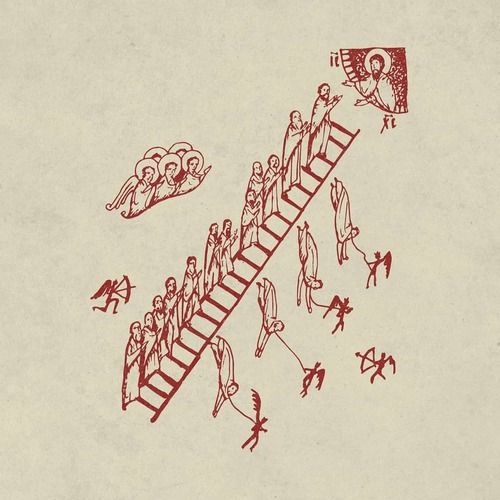
Many centuries later, when all prophecies, visions and premonitions of the Old Testament were finally fulfilled, so was that of Jacob’s Ladder. Jesus Christ brings to mind the image of the ladder when he said to his disciples: “Truly, truly, I say to you, from now on you shall see heaven open, and the angels of God ascending and descending upon the Son of Man.” (John 1:51) In other words, Jesus Christ himself is the ladder, the connection between earth and heaven. It was as a ladder that God came to us in the person of Jesus Christ. He bridged the distance between God and humankind. He came down to earth in order to raise us up to heaven. He became human, that we may become divine, “partakers of divine nature” (2 Peter 1:4). He came to elevate us from this life which is a mere existence of seventy years, more or less, to the fullness of life. He came to lift us from ignorance of God to such personal familiarity with Him that we could address him as “Our Father...” He came to raise us from weakness to power. He came to raise us from the inner hell of sin to the heavenly joy of God’s forgiveness. He came to raise us from the grave of sin and death to freedom and life.
This is how we Christians understand the image of the ladder. We humans do not build the ladder. God lets it down with his grace. The ladder of reconciliation is a gift. We don’t do the building, we do the climbing. Our communion with Christ enables us to climb the ladder of virtue, the ladder of divine ascent. The Orthodox Christian neptic tradition, as expressed in the spiritual writings of the Philokalia understands our spiritual growth and development as a journey rather than a destination. In the famous book “The Ladder - Klimax” by St John of Sinai (580-650AD), the spiritual journey is described in thirty steps. But we should not fool ourselves by thinking that we can climb without faith in God, without communion with Christ. The same author of the Ladder warns: “You will be rejected if you have the effrontery to leap to the top of the ladder of love.” St Gregory of Nyssa also informs us of the paradox of perfection... that there is only one limitation in perfection, that it has no limit. In other words, “when we climb the ladder of spiritual progress, we will never be able to stop ascending; for there is always a step above the step we occupy and there is no summit. Human beings continuously become more spiritual and their spiritual food continuously increases, without their growth ever ending.”
St Isaac the Syrian encourages us to find the ladder and to climb it. But where is the ladder? Where can we find this ladder? He answers:
“Enter into the treasure-vault that lies within you, and you will see the treasure-vault of heaven. For the two are the same, and there is but one single entry to them both. The ladder that leads to the Kingdom is hidden within you, and is found in your soul, and in your soul you will discover the rungs by which you are to ascend.”
A few years ago, I delivered a series of sermons on the thirty steps of the “Ladder”. I will remind you of what those thirty steps were.
Steps one to four have to do with rejecting the worldly ways:
1. Renunciation of the world - apotagi,
2. Detachment from worldly things - aprospatheia
3. Exile from the world - xeniteia
4. Obedience to a spiritual father (guide) - ypakoe
Steps five to seven have to do with the paradox of the sadness of penitence actually being a path to joy and happiness.
5. Repentance - metanoia
6. Remembrance of death - mneme thanatou
7. Mourning - charopoion penthos
Steps eight to seventeen have to do with the defeat of vices and the acquisition of virtue.
8. Freedom from anger (aorgesia)
9. Freedom from holding grudges (mnesikakia)
10. Freedom from slander (katalalia)
11. Freedom from talkativeness or gossip (polylogia)
12. Freedom from lying (pseudos)
13. Freedom from despondency (akedia)
14. Freedom from gluttony (gastrimargia)
15. Freedom from lust = agneia/purity
16. Freedom from the love of money (philargyria)
17. Freedom from possessions = aktemosyne
Steps eighteen to twenty-two have to do with avoiding the traps and obstacles on the spiritual journey:
18. Insensibility - anaesthesia
19. Too much sleep - ypnos
20. Cowardice - deilia
21. Vainglory - kenodoxia
22. Pride - yperephaneia
Steps twenty-three to twenty-nine have to do with the virtues that characterize an enlightened soul:
24. Modesty and simplicity - praoteta & aploteta
25. Humility - tapeinophrosyne
26. Discernment - diakrisis
27. Quietness - hesychia
28. Prayer - proseuche
29. Dispassion - apatheia
And finally step thirty, which links together the three greatest virtues:
30. Faith, hope and love.
Brothers and sisters, the image of the ladder speaks loudly and clearly to modern people. Every one of us is climbing some kind of ladder in this age of “upward mobility”. People today spend an entire lifetime, even sacrificing family and health, in order to climb the ladder..., not of divine ascent, but the ladder of worldly success. How many people come to discover in the end that all was in vain... that they climbed the wrong ladder. The goal for which we sacrificed so much remains unfulfilled. The pursuit of happiness remains unfulfilled and we end up with an inner emptiness that is so painful and unbearable that it often leads to desperate situations - self-isolation, loneliness, depression, suicide.
But here we are, called to climb, encouraged to get up, re-assess our priorities, re-focus our outlook in life, re-define our purpose... change our lives. God let this ladder down into your soul when you were baptized. It is still there. We are called to dive into our soul and start climbing the ladder... one step at a time. And baptism can be renewed. How? Baptism is renewed with the tears of repentance - metanoia. Change of mentality, change of life, change for the better. Listen to what “The Ladder” says:
“The tears that come after baptism are greater than baptism itself, though it may seem rash to say so. Baptism washes off those evils that were previously within us, whereas the sins committed after baptism are washed away by tears. The baptism received by us as children we have all defiled, but we cleanse it anew with our tears. If God in his love for the human race had not given us tears, those being saved would be few indeed and hard to find...”
And this is what we shall talk about next week. The gift of tears - dakrya.