The Nicene Creed
Statement, Summary and Standard of Faith
Part THREe
by Dr Philip Kariatlis
Sub-Dean and Associate Professor of Theology at St Andrew's Theological College
Sub-Dean and Associate Professor of Theology at St Andrew's Theological College
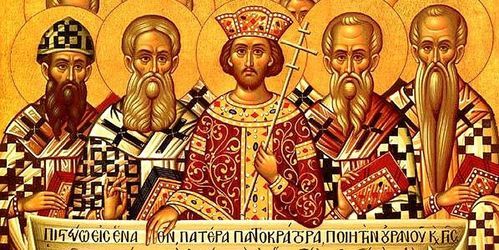
In this article, we continue our study of the main teachings found in the Creed and end our study with a brief look at their importance for us today.
The Spirit of God, the Lord and Giver of Life
Having expounded the faith in God the Father and his Son, the Creed then turns its attention to the Holy Spirit, the third divine Person of the Trinitarian mystery. In the same way that the Creed defends the divinity of the Son, together with his indissoluble unity and distinction with the Father through the ‘homoousion’ and the ‘begotten’ terms, so too does it insist the same with regards to the Spirit of God. In referring to the Spirit of God as ‘Lord’ and ‘giver of life’, the Creed unequivocally underlines the divinity of God’s Spirit since, in the Scriptures, the title ‘Lord’ is specifically set aside for God. For example, in the Psalms we read: “God is Lord and he appeared unto us (Θεός Κύριος καί ἐπέφανεν ἡμῖν), blessed is He that comes in the name of the Lord” (Ps 118:27). Furthermore, in referring to the Spirit in terms of ‘giver of life’, the Creed again demonstrates the divinity of the Spirit – and indeed equality with the Father – in that the Scriptures clearly testify that only God can bestow the gift of life to humanity and the world more generally. Consequently, the Creed is explicit in its affirmation of the Spirit’s divinity.
The intimate fellowship and inseparable unity between the Spirit and the Father – and for that matter the Son of God – is also affirmed; it is seen in the phrase, “who together with the Father and the Son is worshipped and glorified.” The three Persons, precisely because they are divine, are worshipped and glorified together. Furthermore, even though distinct, they cannot be isolated since their unwavering love for each other is so ineffably and unimaginably great that no sooner do we reflect upon their ‘three-ness’, we are immediately led their unity.[1] The late Archbishop Stylianos beautifully – indeed, poetically – characterized the fellowship between the three divine Persons as a “an ineffable and captivating reciprocal embrace of infinite love [ἕνα... ἄρρηκτο καί ἄλληκτο ἀλληλοεναγκαλιασμό ἀπείρου ἀγάπης].”[2] This incidentally also attests to the equal dignity and honour of the Spirit with that of the Father and indeed the Son.
Thirdly, the Creed’s reference to the Spirit as the one “who proceeds from the Father” highlights the Spirit’s own distinct and concrete personal existence as the third divine Person of the Holy Trinity. In the same way that the Creed mentions that the Son’s unique personal mode of existence is that He alone is begotten from the Father, so too does the Creed mention that the Spirit’s distinct mode of existence as a divine Person is that He alone eternally proceeds from the Father. In other words, whereas the Creed articulates the Son as the eternally begotten One, the Spirit alone is said to proceed eternally from the Father. Reference to the procession of the Spirit is highly significant, therefore, in that it explicitly attests to the Spirit’s unity and communion within the life of the Trinity yet at the same time its indivisible differentiation as a divine Person – indeed, as one of the three divine Persons of the Trinitarian mystery.
In teaching that the Holy Spirit proceeds eternally from the Father, the Eastern Orthodox tradition has rejected the Western teaching regarding the Spirit’s procession also from the Son, known in theological text books as the filioque [Latin for ‘and from the Son’], which teaches that the Holy Spirit proceeds from the Father and from the Son. The Eastern Orthodox tradition teaches that Holy Spirit proceeds eternally from the Father alone – that is, not from both the Father and the Son – whilst, He is sent into the world in time, by the Son. The teaching regarding the distinction between the eternal procession of the Holy Spirit from the Father alone, and his temporal mission from the Son, is clearly seen in the gospel according to St John, chapter 15, verse 26:
The text clearly shows that the Holy Spirit proceeds from the Father – ὃ παρὰ τοῦ Πατρὸς ἐκπορεύεται – since the Father alone is the source and beginning of the Godhead. Indeed, the Eastern Orthodox tradition understands the verb ‘ἐκπορεύεται’ to have a special meaning signifying the Spirit's eternal procession from the Father alone. And so, when referring to the eternal procession of the Holy Spirit, which concerns the relations existing within the Trinity from all eternity [the immanent Trinity], the Church attributes the Spirit's procession and existence to the Father alone. It is for this reason that the Eastern Orthodox Church refuses to say that the Spirit also proceeds also from the Son, since this is not the Scriptural use of the verb ‘ἐκπορεύεται’, nor was it understood like this at the Second Ecumenical Council (381AD) which formulated the Church's teaching on the Holy Sprit. However, in referring to the Spirit's temporal mission in the world, then it is clear that the Holy Spirit is in fact sent by Jesus Christ – ὃν ἐγὼ πέμψω.
Failure to distinguish between the two Scriptural verbs ‘ἐκπορεύεται’ and ‘πέμψω’, can consequently easily lead one to believe that the Holy Spirit 'proceeds' from the Father and the Son since the Scriptures mention the Son sending forth the Spirit – but this only concerns the Spirit's temporal mission in the world.[3] To do this, however, would not only introduce two separate principles or sources to the Godhead, which would amount to ditheism, but also distort the equality between the Father, Son and Holy Spirit;[4] that is, an imbalance in the eternal relations is introduced in which the Holy Spirit would be subordinated to the Son. Consequently, in order to avoid introducing two principles into the doctrine of the Holy Trinity and destroying the equality between the three divine persons, the Eastern Orthodox Church rejects the filioque. It relation to the eternal relations between the Father, Son and Holy Spirit, the Eastern Orthodox tradition would claim that the Holy Spirit proceeds eternally from the Father and rests in the Son.[5]
The Salvific and Existential Significance of the Creed for Us Today
It is important to note that the truths depicted above are not some theoretical, speculative doctrines for the so-called ‘professional’ theologians devoid of any practical significance. On the contrary, these eternal truths are important both because they have to do with our salvation – namely, the means by which we too can enter into this fellowship between the Father, Son and Holy Spirit by grace. Furthermore, they are significant because they can inform, indeed transform, the way we live our life on a daily basis.
The significance of the Creed lies in the fact that it does not simply present theoretical truths about God but saving truths. The Creed captures in writing an experience of the early Church’s communion with God and thus it also allows the faithful today into that very same saving experience of the mystery of God. Far from being rigid, inflexible and merely authoritative teachings, the Creed, on the contrary, contains teachings which contribute to a person’s redemption and salvation. It is important to realize, right from the outset, that the Creed has nothing to do with simply adding to our knowledge of God, but its ultimate purpose is to give insights into another way of life, a life without end. Understood as salvific teachings bestowing upon the faithful a kind of foretaste, here and now, of that ‘not-yet’ direct experience where God will be revealed ‘face to face’ (1Cor 13:12), the Creed ought to be seen as one’s commencement upon the path of true life, which is, in the end, a path to freedom. Indeed, the type of freedom that God offers is one which liberates the world even from the bonds of death bestowing upon us the fullness of life. In this way, the truths contained in the Creed offer us salvation: salvation from death and salvation into eternal life where we literally become everything that God is by nature, by grace.
More than beings ‘pointers to salvation’, the teachings contained in the Creed also offer invaluable guidelines for how to live our life as Christians today. Far from being merely informative, the teachings contained in the Creed are ‘pointers to life’ which are able to make a formative, and in the end, transformative impact on our life. Far too often, the doctrines of the Church in general, but more specifically also the teachings found in the Creed, are thought to be speculative abstractions which have nothing to do with life. Moreover, it is often said, that becoming familiar with the doctrines of the Church is of secondary importance, best left to the so-called expert ‘theologians’ since leading a ‘good’ and ‘virtuous’ life is what matters in the long run. On the contrary, however, doctrines in general, but more specifically those foundational ones contained in the Creed, are highly instructive for life. For example, the fact that we believe in one God who is Father, Son and Holy Spirit, uniquely distinct yet at the same time equal and united gives human persons, who are created in the image and likeness of God (Gen 1:26) a paradigm for true living.
In the same way, for example, that the three divine Persons continually embrace one another in an interpenetrating communion of love, completely and continuously open to the other, where their uniqueness does not destroy their unity and communion but rather constitute it, so too are human beings called to embrace the ‘uniqueness of others without this in any way necessarily leading to any division within a community of people. Based on this Trinitarian model, Orthodox theology would claim that difference, diversity and distinctiveness need not lead to separation; on the contrary diversity can be constitutive of unity within human societies. Trinitarian theology tells us that each of us was not created different from each other, but different for each other. In striving to live this truth alone, we would be able radically to transform the way we saw and interacted with others leading to a wonderfully diverse, yet peaceful and tolerant society.
Concluding Remarks
In attempting to explore some of the basic teachings found in the Creed, we were able to show that all these articles of faith are essentially related to the salvation of the world. In so doing, we were able to ascertain that the main tenets of faith as depicted in the Creed, far from being preoccupied with any speculative or presumptive abstractions, are best understood from within a soteriological and existential framework. Specifically, we were able to show that the mystery of diversity in unity as lived eternally by the three divine Persons of the Holy Trinity, is a pattern of life that we are called to emulate, of course in a creaturely way. As such, it is not enough to become familiar with these truths but also and more appropriately to sing praises to the Trinitarian Godhead, to bow in awe before the incomprehensible mystery of divine Love, to be bathed by its splendor, and to pray to be gifted with the grace so openly flowing out of this Love, so that we may be enabled to live lovingly in this life, namely, selflessly orientated always towards the ‘other’, who ultimately is our ‘nearest god’.[6]
Footnotes
[1] St Gregory the Theologian described it in the following way: “No sooner do I conceive the unity than the Trinity bathes me in its splendour. And when I think of the Trinity, again the unity seizes me and my eyes are filled, and the greater part of what I am thinking escapes me.” Oration, 40. 41, PG 36:417.
[2] Στό Περιθώριο τοῦ Διαλόγου (Athens: Domos, 1991), 116
[3] St John of Damascus wrote: “Likewise, we believe also in one Holy Spirit, the Lord and Giver of Life: who proceeds from the Father, the Father being the only cause… proceeding from the Father and communicated through the Son. And participated in by all creation… And we speak likewise of the Holy Spirit as from the Father, and call him the Spirit of the Father. And we do not speak of the Spirit as from the Son… and we confess that He is manifested and imparted to us through the Son…But the Holy Spirit of the Father as proceeding from the Father, for there is no impulse without the Spirit. And we also speak of the Spirit of the Son, not as though proceeding from him, but proceeding through him from the Father. For the Father alone is the cause.” Exposition of the Orthodox Faith 1, 8,12. P.G. 94. 821-833 and 849.
[4] The West responds to these objections by stating that the Spirit proceeds from the Father and the Son “as from one principle [tanquam ab uno principio]”. According to the Eastern Orthodox tradition, such a response reduces and confuses the persons of the Father and the Son, thus making the persons merely different aspects in which the one God appears; something which the East rejects, since it upholds that persons are concrete and unique modes of real existence. Furthermore, the filioque also ends up making the essence the principle of unity, and not the person of the Father, but the abstract essence of God. From this, there arises the danger of undermining the fact that God is personal, and believing instead that He is an abstract essence in which various relations can be distinguished. As we have shown, the East does not identify 'person' with mere relations as Thomas Aquinas (1224-1274AD) had done in the West by stating that personae sunt ipsaet relationes [persons are the relations themselves]. Relations are personal characteristics of persons, but not the persons themselves.
[5] For example, the Doxastikon of the Sunday of Pentecost Vespers clearly brings to light this Trinitarian aspect of the feast day: "Come all you people, let us worship the Godhead of three hypostases: the Son in the Father, with the Holy Spirit; for the Father timelessly begat the Son, who is co-eternal and of one throne; and the Holy Spirit was in the Father, glorified with the Son; one might, one essence, one Godhead, which we all worship saying: Holy God who created all things through the Son, with the cooperation of the Holy Spirit; holy Mighty, through whom we have known the Father, and through whom the Holy Spirit came into the world; holy Immortal, the comforting Spirit, who proceeds from the Father and rests in the Son. O holy Trinity, glory be to you." This hymn is attributed to Emperor Leo VI (886-912AD).
[6] Archbishop Stylianos of Australia, in a poem entitled ‘The Other’ written in Perth, on 24-5-76. The entire poem reads: The Other/ The other is ineffable/ neither small nor large/ an anonymous yearning/ regardless/ of how familiar or distant/ he is my nearest god. / However different the other/ much more/ astonishing/ is my Lord and God/ only in touching him/ am I ecstatically redeemed/ in the fulfilment of the world.
The Spirit of God, the Lord and Giver of Life
Having expounded the faith in God the Father and his Son, the Creed then turns its attention to the Holy Spirit, the third divine Person of the Trinitarian mystery. In the same way that the Creed defends the divinity of the Son, together with his indissoluble unity and distinction with the Father through the ‘homoousion’ and the ‘begotten’ terms, so too does it insist the same with regards to the Spirit of God. In referring to the Spirit of God as ‘Lord’ and ‘giver of life’, the Creed unequivocally underlines the divinity of God’s Spirit since, in the Scriptures, the title ‘Lord’ is specifically set aside for God. For example, in the Psalms we read: “God is Lord and he appeared unto us (Θεός Κύριος καί ἐπέφανεν ἡμῖν), blessed is He that comes in the name of the Lord” (Ps 118:27). Furthermore, in referring to the Spirit in terms of ‘giver of life’, the Creed again demonstrates the divinity of the Spirit – and indeed equality with the Father – in that the Scriptures clearly testify that only God can bestow the gift of life to humanity and the world more generally. Consequently, the Creed is explicit in its affirmation of the Spirit’s divinity.
The intimate fellowship and inseparable unity between the Spirit and the Father – and for that matter the Son of God – is also affirmed; it is seen in the phrase, “who together with the Father and the Son is worshipped and glorified.” The three Persons, precisely because they are divine, are worshipped and glorified together. Furthermore, even though distinct, they cannot be isolated since their unwavering love for each other is so ineffably and unimaginably great that no sooner do we reflect upon their ‘three-ness’, we are immediately led their unity.[1] The late Archbishop Stylianos beautifully – indeed, poetically – characterized the fellowship between the three divine Persons as a “an ineffable and captivating reciprocal embrace of infinite love [ἕνα... ἄρρηκτο καί ἄλληκτο ἀλληλοεναγκαλιασμό ἀπείρου ἀγάπης].”[2] This incidentally also attests to the equal dignity and honour of the Spirit with that of the Father and indeed the Son.
Thirdly, the Creed’s reference to the Spirit as the one “who proceeds from the Father” highlights the Spirit’s own distinct and concrete personal existence as the third divine Person of the Holy Trinity. In the same way that the Creed mentions that the Son’s unique personal mode of existence is that He alone is begotten from the Father, so too does the Creed mention that the Spirit’s distinct mode of existence as a divine Person is that He alone eternally proceeds from the Father. In other words, whereas the Creed articulates the Son as the eternally begotten One, the Spirit alone is said to proceed eternally from the Father. Reference to the procession of the Spirit is highly significant, therefore, in that it explicitly attests to the Spirit’s unity and communion within the life of the Trinity yet at the same time its indivisible differentiation as a divine Person – indeed, as one of the three divine Persons of the Trinitarian mystery.
In teaching that the Holy Spirit proceeds eternally from the Father, the Eastern Orthodox tradition has rejected the Western teaching regarding the Spirit’s procession also from the Son, known in theological text books as the filioque [Latin for ‘and from the Son’], which teaches that the Holy Spirit proceeds from the Father and from the Son. The Eastern Orthodox tradition teaches that Holy Spirit proceeds eternally from the Father alone – that is, not from both the Father and the Son – whilst, He is sent into the world in time, by the Son. The teaching regarding the distinction between the eternal procession of the Holy Spirit from the Father alone, and his temporal mission from the Son, is clearly seen in the gospel according to St John, chapter 15, verse 26:
When the Advocate comes, whom I will send [ὃν ἐγὼ πέμψω] to you from the Father, the Spirit of truth who proceeds from the Father [ὃ παρὰ τοῦ Πατρὸς ἐκπορεύεται], he will testify on my behalf.
The text clearly shows that the Holy Spirit proceeds from the Father – ὃ παρὰ τοῦ Πατρὸς ἐκπορεύεται – since the Father alone is the source and beginning of the Godhead. Indeed, the Eastern Orthodox tradition understands the verb ‘ἐκπορεύεται’ to have a special meaning signifying the Spirit's eternal procession from the Father alone. And so, when referring to the eternal procession of the Holy Spirit, which concerns the relations existing within the Trinity from all eternity [the immanent Trinity], the Church attributes the Spirit's procession and existence to the Father alone. It is for this reason that the Eastern Orthodox Church refuses to say that the Spirit also proceeds also from the Son, since this is not the Scriptural use of the verb ‘ἐκπορεύεται’, nor was it understood like this at the Second Ecumenical Council (381AD) which formulated the Church's teaching on the Holy Sprit. However, in referring to the Spirit's temporal mission in the world, then it is clear that the Holy Spirit is in fact sent by Jesus Christ – ὃν ἐγὼ πέμψω.
Failure to distinguish between the two Scriptural verbs ‘ἐκπορεύεται’ and ‘πέμψω’, can consequently easily lead one to believe that the Holy Spirit 'proceeds' from the Father and the Son since the Scriptures mention the Son sending forth the Spirit – but this only concerns the Spirit's temporal mission in the world.[3] To do this, however, would not only introduce two separate principles or sources to the Godhead, which would amount to ditheism, but also distort the equality between the Father, Son and Holy Spirit;[4] that is, an imbalance in the eternal relations is introduced in which the Holy Spirit would be subordinated to the Son. Consequently, in order to avoid introducing two principles into the doctrine of the Holy Trinity and destroying the equality between the three divine persons, the Eastern Orthodox Church rejects the filioque. It relation to the eternal relations between the Father, Son and Holy Spirit, the Eastern Orthodox tradition would claim that the Holy Spirit proceeds eternally from the Father and rests in the Son.[5]
The Salvific and Existential Significance of the Creed for Us Today
It is important to note that the truths depicted above are not some theoretical, speculative doctrines for the so-called ‘professional’ theologians devoid of any practical significance. On the contrary, these eternal truths are important both because they have to do with our salvation – namely, the means by which we too can enter into this fellowship between the Father, Son and Holy Spirit by grace. Furthermore, they are significant because they can inform, indeed transform, the way we live our life on a daily basis.
The significance of the Creed lies in the fact that it does not simply present theoretical truths about God but saving truths. The Creed captures in writing an experience of the early Church’s communion with God and thus it also allows the faithful today into that very same saving experience of the mystery of God. Far from being rigid, inflexible and merely authoritative teachings, the Creed, on the contrary, contains teachings which contribute to a person’s redemption and salvation. It is important to realize, right from the outset, that the Creed has nothing to do with simply adding to our knowledge of God, but its ultimate purpose is to give insights into another way of life, a life without end. Understood as salvific teachings bestowing upon the faithful a kind of foretaste, here and now, of that ‘not-yet’ direct experience where God will be revealed ‘face to face’ (1Cor 13:12), the Creed ought to be seen as one’s commencement upon the path of true life, which is, in the end, a path to freedom. Indeed, the type of freedom that God offers is one which liberates the world even from the bonds of death bestowing upon us the fullness of life. In this way, the truths contained in the Creed offer us salvation: salvation from death and salvation into eternal life where we literally become everything that God is by nature, by grace.
More than beings ‘pointers to salvation’, the teachings contained in the Creed also offer invaluable guidelines for how to live our life as Christians today. Far from being merely informative, the teachings contained in the Creed are ‘pointers to life’ which are able to make a formative, and in the end, transformative impact on our life. Far too often, the doctrines of the Church in general, but more specifically also the teachings found in the Creed, are thought to be speculative abstractions which have nothing to do with life. Moreover, it is often said, that becoming familiar with the doctrines of the Church is of secondary importance, best left to the so-called expert ‘theologians’ since leading a ‘good’ and ‘virtuous’ life is what matters in the long run. On the contrary, however, doctrines in general, but more specifically those foundational ones contained in the Creed, are highly instructive for life. For example, the fact that we believe in one God who is Father, Son and Holy Spirit, uniquely distinct yet at the same time equal and united gives human persons, who are created in the image and likeness of God (Gen 1:26) a paradigm for true living.
In the same way, for example, that the three divine Persons continually embrace one another in an interpenetrating communion of love, completely and continuously open to the other, where their uniqueness does not destroy their unity and communion but rather constitute it, so too are human beings called to embrace the ‘uniqueness of others without this in any way necessarily leading to any division within a community of people. Based on this Trinitarian model, Orthodox theology would claim that difference, diversity and distinctiveness need not lead to separation; on the contrary diversity can be constitutive of unity within human societies. Trinitarian theology tells us that each of us was not created different from each other, but different for each other. In striving to live this truth alone, we would be able radically to transform the way we saw and interacted with others leading to a wonderfully diverse, yet peaceful and tolerant society.
Concluding Remarks
In attempting to explore some of the basic teachings found in the Creed, we were able to show that all these articles of faith are essentially related to the salvation of the world. In so doing, we were able to ascertain that the main tenets of faith as depicted in the Creed, far from being preoccupied with any speculative or presumptive abstractions, are best understood from within a soteriological and existential framework. Specifically, we were able to show that the mystery of diversity in unity as lived eternally by the three divine Persons of the Holy Trinity, is a pattern of life that we are called to emulate, of course in a creaturely way. As such, it is not enough to become familiar with these truths but also and more appropriately to sing praises to the Trinitarian Godhead, to bow in awe before the incomprehensible mystery of divine Love, to be bathed by its splendor, and to pray to be gifted with the grace so openly flowing out of this Love, so that we may be enabled to live lovingly in this life, namely, selflessly orientated always towards the ‘other’, who ultimately is our ‘nearest god’.[6]
Footnotes
[1] St Gregory the Theologian described it in the following way: “No sooner do I conceive the unity than the Trinity bathes me in its splendour. And when I think of the Trinity, again the unity seizes me and my eyes are filled, and the greater part of what I am thinking escapes me.” Oration, 40. 41, PG 36:417.
[2] Στό Περιθώριο τοῦ Διαλόγου (Athens: Domos, 1991), 116
[3] St John of Damascus wrote: “Likewise, we believe also in one Holy Spirit, the Lord and Giver of Life: who proceeds from the Father, the Father being the only cause… proceeding from the Father and communicated through the Son. And participated in by all creation… And we speak likewise of the Holy Spirit as from the Father, and call him the Spirit of the Father. And we do not speak of the Spirit as from the Son… and we confess that He is manifested and imparted to us through the Son…But the Holy Spirit of the Father as proceeding from the Father, for there is no impulse without the Spirit. And we also speak of the Spirit of the Son, not as though proceeding from him, but proceeding through him from the Father. For the Father alone is the cause.” Exposition of the Orthodox Faith 1, 8,12. P.G. 94. 821-833 and 849.
[4] The West responds to these objections by stating that the Spirit proceeds from the Father and the Son “as from one principle [tanquam ab uno principio]”. According to the Eastern Orthodox tradition, such a response reduces and confuses the persons of the Father and the Son, thus making the persons merely different aspects in which the one God appears; something which the East rejects, since it upholds that persons are concrete and unique modes of real existence. Furthermore, the filioque also ends up making the essence the principle of unity, and not the person of the Father, but the abstract essence of God. From this, there arises the danger of undermining the fact that God is personal, and believing instead that He is an abstract essence in which various relations can be distinguished. As we have shown, the East does not identify 'person' with mere relations as Thomas Aquinas (1224-1274AD) had done in the West by stating that personae sunt ipsaet relationes [persons are the relations themselves]. Relations are personal characteristics of persons, but not the persons themselves.
[5] For example, the Doxastikon of the Sunday of Pentecost Vespers clearly brings to light this Trinitarian aspect of the feast day: "Come all you people, let us worship the Godhead of three hypostases: the Son in the Father, with the Holy Spirit; for the Father timelessly begat the Son, who is co-eternal and of one throne; and the Holy Spirit was in the Father, glorified with the Son; one might, one essence, one Godhead, which we all worship saying: Holy God who created all things through the Son, with the cooperation of the Holy Spirit; holy Mighty, through whom we have known the Father, and through whom the Holy Spirit came into the world; holy Immortal, the comforting Spirit, who proceeds from the Father and rests in the Son. O holy Trinity, glory be to you." This hymn is attributed to Emperor Leo VI (886-912AD).
[6] Archbishop Stylianos of Australia, in a poem entitled ‘The Other’ written in Perth, on 24-5-76. The entire poem reads: The Other/ The other is ineffable/ neither small nor large/ an anonymous yearning/ regardless/ of how familiar or distant/ he is my nearest god. / However different the other/ much more/ astonishing/ is my Lord and God/ only in touching him/ am I ecstatically redeemed/ in the fulfilment of the world.