SUNDAY OF THE VENERATION OF THE HOLY CROSS
Sermon by H.G Bishop Emilianos of Meloa, 19th March 2017
The Lord said: "If anyone wishes to come after me, let him deny himself and take up his cross and follow me. For whoever would save his life will lose it; and whoever loses his life for my sake and the gospel's will save it. For what does it profit a man, to gain the whole world and forfeit his life? For what can a man give in return for his life? For whoever is ashamed of me and my words in this adulterous and sinful generation, of him will the Son of man also be ashamed, when he comes in the glory of his Father with the holy angels." And he said to them, "Truly, I say to you, there are some standing here who will not taste death before they see the kingdom of God come with power" (Mark 8:34-38; 9:1).
"If anyone wishes to come after me, let him deny himself and take up his cross and follow me”. These are three different things and yet related to each other. Christ asks us to firstly deny ourselves. In other words to empty ourselves from everything relevant to us. We then need to take up our cross, lift up and carry our cross, and finally to follow Him.
To deny ourselves is a cross. But the next thing the Gospel talks about, to follow Christ, is a cross also. Our cross includes these two. When we take up our cross this way, we become Christ-like. Unified. One. He was God, He became human, but He was One. This unification of denying ourselves and following Him makes us like Christ. One with Christ. We could then say that we are crucified but, with authority.
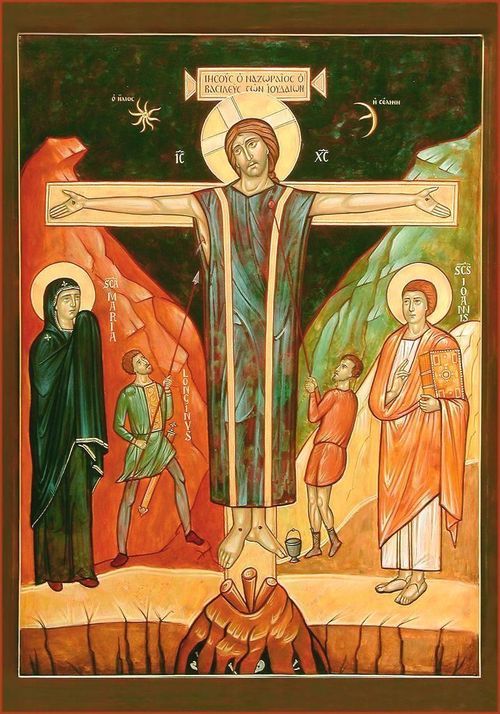
There is an old and rare icon which displays Jesus on the cross in a different way to how He is usually depictured. His face is not sad but meek and humble. His eyes are not shut but open and affectionate. He does not appear hanging from the cross but standing on it. Looks like there is no gravity. His shoulders are on the same level with His crucified hands. He is willingly keeping His hands and feet under the crucifixion nails. He is not naked but is wearing the bishop’s inner vestment, a ‘stihario’ with the ‘rivers’ on both sides, which symbolise the gifts of preaching. Christ on the cross with authority!
The symbolism of this icon is crucial for understanding what it means to deny ourselves, follow Christ and be joyful on the cross. To be able to live our Christian life without anxieties and fears. As an Athonite father once said: “Keep your mind in the Union (with God) and be afraid of nothing”.
Firstly, we do not submit like slaves or labourers, but like sons we match our will with God’s Will. As sons of God we gradually develop Holy Grace within us. Starting from the union of our own will with God’s will, we advance to spiritual Union with God, to the development of His likeness inside us. By staying attached to this Union, every problem inside and around us disappears. The enemies and our temptations become our benefactors. They help us develop patience and humility.
Although problems continue, they stop bothering us. Even death becomes our resurrection. Having this knowledge, the foreknowledge and the faith, we are afraid of nothing. We stand on our cross with authority. We have God as our Father and Protector. Who could ever hurt our soul? No one. It is impossible to be hurt by anyone and impossible to be separated from our Father, unless we want to. Even if we make mistakes and we fall, by returning to this Union we become unbeatable once again. “Keep your mind in this Oneness and be afraid of nothing”.
To deny ourselves and follow Christ, we could say are the two separate parts of the cross. The cross has two parts. The vertical and the horizontal. If we deny ourselves - something we could do as humans, using our love - this would be like the horizontal part of the cross. And to follow Christ, to become like Christ, to be united with Him in order to be carried forward to Heaven, is like the vertical part of the cross. It extends and unites earth with Heavens.
If we deny ourselves and we take up our cross but not in Jesus’ name, then we could say that all our sacrifices would be without essence, without real value. A lot of people have denied themselves and have taken up a cross. The best example would probably be one of the national martyrs. They sacrificed themselves for their country. This did not make them Holy Martyrs though. They are not Saints. We can also sacrifice ourselves for other beliefs we have. This is not enough to sanctify us. Denying ourselves and taking up a cross, a belief, a way of life; if it does not happen in the name of Jesus Christ, might still be admirable but does not result in eternal life.
Also, if we follow Christ without denying ourselves, we become dangerous to both ourselves and everyone else around us. When the end of time will come, Jesus will tell us: “I do not know you”. He will say this to us because we did not get to know Christ. And the reason was that we never denied ourselves. We might be going to Church, chant or celebrate the Divine Liturgy all our lives, thinking that we are somebody. Or we might be giving donations and expect our names to be written in a visible enormous inscription. Or we might think that our family should be thanking us for taking care of them. Would this ‘thank you’ make a difference if we are as we should be? If we act with pure love? We would have done the same with or without a ‘thank you’. But, if we are not as we should be, if we expect it and our ego is craving to be fed by this ‘thank you’, it would make a big difference. It would cost us in case we do not receive it. If our motive is just to show off, we will not be happy without a ‘thank you’ and this ‘thank you’ will dignify us.
Without denying ourselves it is impossible to follow Christ. And in case we claim we do, we just “use God’s name in vain” (Ex. 20,7). Vanity. In reality, we follow ourselves. We want ourselves to be glorified and we use Jesus’ name to show that we have achieved something, avoiding at the same time the risk of being called show-offs. We do not offer our sacrifice to Christ. We advertise ourselves. In His name we increase our pride and therefore the distance from Him. This is why the young man that the Gospel mentions about somewhere else, left Christ being sad (Mark 10,22). He wanted to follow Him and the Lord suggested that he gave up everything. This sadness indicates self-defence. We defend a huge ‘ego’. We can often grow it inside us greater than God Himself. Unfortunately, in the name of this ‘ego’ we deny our cross, which is: to deny ourselves and to follow Christ.
"If anyone wishes to come after me, let him deny himself and take up his cross and follow me”. These are three different things and yet related to each other. Christ asks us to firstly deny ourselves. In other words to empty ourselves from everything relevant to us. We then need to take up our cross, lift up and carry our cross, and finally to follow Him.
To deny ourselves is a cross. But the next thing the Gospel talks about, to follow Christ, is a cross also. Our cross includes these two. When we take up our cross this way, we become Christ-like. Unified. One. He was God, He became human, but He was One. This unification of denying ourselves and following Him makes us like Christ. One with Christ. We could then say that we are crucified but, with authority.
There is an old and rare icon which displays Jesus on the cross in a different way to how He is usually depictured. His face is not sad but meek and humble. His eyes are not shut but open and affectionate. He does not appear hanging from the cross but standing on it. Looks like there is no gravity. His shoulders are on the same level with His crucified hands. He is willingly keeping His hands and feet under the crucifixion nails. He is not naked but is wearing the bishop’s inner vestment, a ‘stihario’ with the ‘rivers’ on both sides, which symbolise the gifts of preaching. Christ on the cross with authority!
The symbolism of this icon is crucial for understanding what it means to deny ourselves, follow Christ and be joyful on the cross. To be able to live our Christian life without anxieties and fears. As an Athonite father once said: “Keep your mind in the Union (with God) and be afraid of nothing”.
Firstly, we do not submit like slaves or labourers, but like sons we match our will with God’s Will. As sons of God we gradually develop Holy Grace within us. Starting from the union of our own will with God’s will, we advance to spiritual Union with God, to the development of His likeness inside us. By staying attached to this Union, every problem inside and around us disappears. The enemies and our temptations become our benefactors. They help us develop patience and humility.
Although problems continue, they stop bothering us. Even death becomes our resurrection. Having this knowledge, the foreknowledge and the faith, we are afraid of nothing. We stand on our cross with authority. We have God as our Father and Protector. Who could ever hurt our soul? No one. It is impossible to be hurt by anyone and impossible to be separated from our Father, unless we want to. Even if we make mistakes and we fall, by returning to this Union we become unbeatable once again. “Keep your mind in this Oneness and be afraid of nothing”.
To deny ourselves and follow Christ, we could say are the two separate parts of the cross. The cross has two parts. The vertical and the horizontal. If we deny ourselves - something we could do as humans, using our love - this would be like the horizontal part of the cross. And to follow Christ, to become like Christ, to be united with Him in order to be carried forward to Heaven, is like the vertical part of the cross. It extends and unites earth with Heavens.
If we deny ourselves and we take up our cross but not in Jesus’ name, then we could say that all our sacrifices would be without essence, without real value. A lot of people have denied themselves and have taken up a cross. The best example would probably be one of the national martyrs. They sacrificed themselves for their country. This did not make them Holy Martyrs though. They are not Saints. We can also sacrifice ourselves for other beliefs we have. This is not enough to sanctify us. Denying ourselves and taking up a cross, a belief, a way of life; if it does not happen in the name of Jesus Christ, might still be admirable but does not result in eternal life.
Also, if we follow Christ without denying ourselves, we become dangerous to both ourselves and everyone else around us. When the end of time will come, Jesus will tell us: “I do not know you”. He will say this to us because we did not get to know Christ. And the reason was that we never denied ourselves. We might be going to Church, chant or celebrate the Divine Liturgy all our lives, thinking that we are somebody. Or we might be giving donations and expect our names to be written in a visible enormous inscription. Or we might think that our family should be thanking us for taking care of them. Would this ‘thank you’ make a difference if we are as we should be? If we act with pure love? We would have done the same with or without a ‘thank you’. But, if we are not as we should be, if we expect it and our ego is craving to be fed by this ‘thank you’, it would make a big difference. It would cost us in case we do not receive it. If our motive is just to show off, we will not be happy without a ‘thank you’ and this ‘thank you’ will dignify us.
Without denying ourselves it is impossible to follow Christ. And in case we claim we do, we just “use God’s name in vain” (Ex. 20,7). Vanity. In reality, we follow ourselves. We want ourselves to be glorified and we use Jesus’ name to show that we have achieved something, avoiding at the same time the risk of being called show-offs. We do not offer our sacrifice to Christ. We advertise ourselves. In His name we increase our pride and therefore the distance from Him. This is why the young man that the Gospel mentions about somewhere else, left Christ being sad (Mark 10,22). He wanted to follow Him and the Lord suggested that he gave up everything. This sadness indicates self-defence. We defend a huge ‘ego’. We can often grow it inside us greater than God Himself. Unfortunately, in the name of this ‘ego’ we deny our cross, which is: to deny ourselves and to follow Christ.