
STILLNESS - HESYCHIA
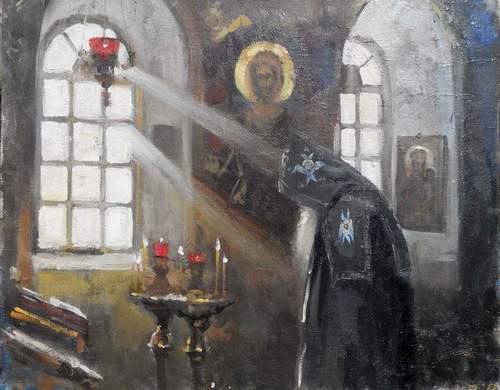
Part Twelve, 1 April 2012
Philokalia: Love of Beauty & Goodness
Series by Fr Gerasimos Koutsouras
St George Church, Rose Bay Sermons
Philokalia: Love of Beauty & Goodness
Series by Fr Gerasimos Koutsouras
St George Church, Rose Bay Sermons
About one thousand six hundred years ago a holy Christian elder called together his fellow monks at dinner time. He poured some water into a wooden bowl and he said to them: “Look at the water. What do you see?” The other monks had a look and answered him: “We see water”. “Correct” said the elder. A minute later, when the water had stood still, he asked them again: “Look at the water. What do you see?” The other monks had a look again. This time they saw their faces reflected in the water. In this way the elder wanted to give them a lesson about the value of stillness, quietness and calm. That self-knowledge does not come with disturbance, with noise, with hustle and bustle. But self-knowledge comes when we are still, quiet, silent and calm.
The Greek word for quiet is hesychia. And in our Orthodox Christian Spiritual tradition, hesychia is one of the most important values for an enlightened Christian. So much so, that the entire mystical method that we have been talking about for the last twelve Sundays, things like the prayer of the mind, e noera proseuche, in fact the entire neptic tradition, has been called by Western Scholars hesychasm (hesychasmos), the way of stillness. But hesychia is not a way of life just for monks and hermits. It is something that all of us can apply in our daily life.
We live in a noisy world. Cars, TVs, radios, machines, computer games, computer media, computer everything. When was the last time we experienced silence? Studies have repeatedly linked noise pollution to a variety of conditions ranging from hearing problems to insomnia, ulcers, high blood pressure and heart disease. The Danish philosopher Kierkegard said: “The present state of the world and the whole of life is diseased. If I were a doctor and were asked for my advice, I would reply: ‘Create silence! Bring people into silence’.”
And yet we continue to live with noise. Why? Ernesto Cardenal wrote: “Modern humans always try to run away from themselves. They can never be silent or alone, because that would mean to be alone with themselves... and that is why the places of amusement... are always filled with people. And when they do find themselves alone and are at the point where they might encounter God, they turn on the radio or the television.”
For most people, silence is to be avoided at all costs. For them, and that is most of us, silence is emptiness and boredom. If we are empty inside, then the silence too is empty. Silence confronts us with our inner emptiness, and that is very unsettling. We will do anything to fill the void, busy-ness for the sake of busy-ness, entertainment for the sake of entertainment, ...anything will do!
And yet, that silence is actually an opportunity. That silence is special. That silence is the right time to discover what’s in here [point to heart], to learn, to feel, to tune in to the frequency of the Spirit. It is no accident that the English language has two words for being alone. Loneliness and solitude. Loneliness is negative and not good, but solitude is positive and healthy. It is in solitude that some of the greatest discoveries have been made. Archimedes discovered the law of specific gravity while relaxing silently in his bath upon which he shouted “Eureka!” - “I found it!” Galileo discovered the principle of the pendulum while praying silently in the cathedral of Pisa. When today’s scientists would wrest some secret of nature, they do not set up in the middle of a shopping centre, but in some quiet and remote laboratory, where they wait for nature to speak. In music, the rests and pauses, the intervals of silence, are extremely important... they also speak. It is in moments of silence that we will perceive the Spirit communicating with us also.
Let’s connect this to the Bible. In the First Book of Kings, we read about the prophet Elia (Elijah). Being persecuted by his countrymen for his outspokenness in the name of the true God, he withdraws to the wilderness and is forced to live in a cave. He experiences a windstorm. He experiences an earthquake. He experiences a fire. But the Spirit of God says the scriptural narrative was not in the windstorm, not in the earthquake, not in the fire... the spirit of God was in the voice of a gentle breeze [φωνή αύρας λεπτής - phone auras leptis].
What about Jesus Christ himself? The Gospel of Mark describes a typical day for Jesus in the town of Capernaum. Entering the town he taught in the synagogue. Then he restored health to a mentally ill man. After that he went to Simon’s house where he healed the mother-in-law. In the evening he ministered to the sick of the town... Where did he get the strength? The gospel provides the answer. The next morning, a great while before sunrise, Jesus rose and went out to a lonely place. Αnd there... he prayed. And we have many such examples of Jesus going out to ‘lonely places’ to pray. For him, they were places of power, places of strength and of peace.
Following the example of the Lord Jesus, subsequent generations of Christians also found value in stillness and quietness.
St John of Sinai [of the Ladder] said: “Silence is the mother of prayer... a continuous ascension to heaven.”
St Isaac the Syrian said: “Love silence diligently, for in it your soul finds life.”
St Poimen of Egypt said: “If you have silence, you will have peace, wherever you might live.”
Also from Egypt we have the story of when an Archbishop decided to go and visit the hermits in the desert. The younger monks were excited about the visit from such a V.I.P. as we would say today. They decided to take him to one of the wisest elders, Fr Pambo. But Fr Pambo sat there in silence and did not speak to him. When the brethren finally said to Pambo, “Father, say something to the Archbishop so that he may be edified, he replied, if he is not edified by my silence, he will not be edified by my speech.”
The mathematician and inventor, Blaise Pascal, famously said: “Silence. All human unhappiness comes from not knowing how to stay quietly in a room.”
Brothers and sisters, if there is one thing we can take home with us today, it is that we need to learn the value of silence. To appreciate those quiet moments of life. Not to relentlessly fill those moments with noise. To actually set aside some time for stillness, for prayer, for spiritual awareness. To switch mobiles off, to switch TVs off. When driving home from work, to take a detour, to drive past the church do the sign of the cross and say a prayer. If the doors are open, actually park the car, come in, light a candle, sit down and spend some time in silence.
Which brings us to the spiritual topic we will talk about next Sunday, unifying the mind with the heart - harmonising the intellect with the soul.