SYNERGY
Part Eleven, 25 April 2012
Philokalia: Love of Beauty & Goodness
Series by Fr Gerasimos Koutsouras
St George Church, Rose Bay Sermons
Philokalia: Love of Beauty & Goodness
Series by Fr Gerasimos Koutsouras
St George Church, Rose Bay Sermons
A very important word in Orthodox Christian spirituality is the word synergy. It is used in the Bible in the First Letter to the Corinthians 3:9 “We are God’s coworkers, God’s field, you are God’s building.” {θεού γαρ εσμέν συνεργοί, θεού γεώργιον, θεού οικοδομή εστε}. The word synergy comes from two words syn which means with, together with, and ergon meaning work. Work together. We cooperate, He works with us. We work with him.
St Isaac the Syrian said:
“For the Christian, no thought, no feeling, no action can come from the Gospel without the help of God’s grace. Humans for their part, bring the desire, but God gives the grace, and it is from this mutual activity, or synergy [synergeia], that Christian personality is born.
God wants free will partners. He created us to be his sons and daughters, not his blind slaves. Once we come to know him, we do call ourselves his servants, but we do so willingly, out of love, not compulsion. God offers us the gift of eternal life, but it is up to us to accept it or reject it.
“Draw near to God, and he will draw near to you.” says the Apostle James (James 4:8).
St Makarios of Egypt is quoted in the Philokalia:
“We receive salvation by grace and as a divine gift of the Spirit. But to attain the full measure of virtue we need also to possess faith and love, and to struggle to exercise our free will with integrity. In this manner, we inherit eternal life as a consequence of both grace and justice. We do not reach the final stage of spiritual maturity through divine power and grace alone, without ourselves making any effort; but neither on the other hand do we attain the final measure of freedom and purity as a result of our own diligence and strength alone, separate from any divine assistance. If the Lord does not build the house, it is said, and protect the city, in vain does the guard stay awake, and in vain do the labourer and the builder work. (Ps. 127:14)”
But synergy must not be understood as a 50 - 50 arrangement. We are not equal to God. It is more like 99.9% God’s work. And yet our bit, the 0.01% is crucial. We need to respond to the grace being offered to us. We can choose with our free will, to accept the gift being offered to us, or we can easily reject it.
In the early 1800s, a man in America named George Wilson had murdered someone who found him trying to rob the mail. He was tried and sentenced to be executed by hanging. However, the President Andrew Jackson sent him a pardon. To everyone’s shock, Wilson refused to accept the pardon and no one knew what to do legally. The case went to the Supreme Court. The Chief Justice wrote the decision: “ A pardon is a slip of paper, the value of which is determined by the acceptance of the person to be pardoned. If it is refused, it is no pardon. George Wilson must be hanged.” And he was. So it is with us. We can choose to accept or reject God’s gift of redemption.
St Augustine said this gem: “Without God we cannot, without us God will not.”
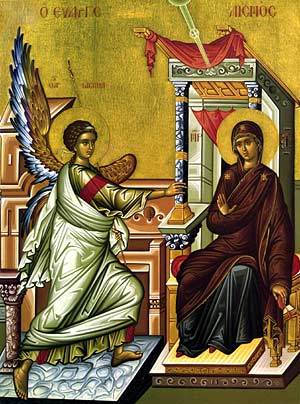
Probably the greatest example of synergy is Panayia, Theotokos. Today is the 25th of March, the day we commemorate the Annunciation, the Evangelismos. Look at the icon of the Evangelismo. She is offered the gift, the glad tiding is announced to her. And yet, she is not a robot, she has free will. She questions first, “How?” She then proceeds to accept with faith what is the divine will. You can read all that in the simple way her hand is depicted in the icon.
Mary stands as the greatest example of humanity’s free response to God’s offer of salvation. She stands as an example of synergy, or co-operation between humans and God. And we honour her today, because she represented us, all of humanity, and what we are invited to do in our life.
The third century scholar Origenes of Alexandria describes the relationship between human effort and God’s grace by using the metaphor, the image of a ship, its sails and the wind. The wind is there... blowing, but the ship will go nowhere unless the sailor is able to put up the sails and harness the wind. This is synergy. Both are wind and sails are needed. In the same way, there is no point praying to God for friendship and love between us and our friends, family, or acquaintances unless we ourselves make an effort to befriend, reconcile, forgive and love the people around us.
Orthodox Christianity believes that humans cannot be saved separate from the action of God. Humans cannot save themselves, but neither are they robots. Having been endowed by God with free will, we have a real, though limited part to play in our salvation. Under no condition, does synergy mean that we become our own co-redeemer and co-saviour with Jesus Christ. Otherwise, that would be like us saying: “I am the pilot and God is my co-pilot.” And that is a precarious way to fly a plane. I am the pilot and God is my back up. No, it should be the other way around. Amen.
Next week we shall talk about the precious value of hesychia-quietness.
Mary stands as the greatest example of humanity’s free response to God’s offer of salvation. She stands as an example of synergy, or co-operation between humans and God. And we honour her today, because she represented us, all of humanity, and what we are invited to do in our life.
The third century scholar Origenes of Alexandria describes the relationship between human effort and God’s grace by using the metaphor, the image of a ship, its sails and the wind. The wind is there... blowing, but the ship will go nowhere unless the sailor is able to put up the sails and harness the wind. This is synergy. Both are wind and sails are needed. In the same way, there is no point praying to God for friendship and love between us and our friends, family, or acquaintances unless we ourselves make an effort to befriend, reconcile, forgive and love the people around us.
Orthodox Christianity believes that humans cannot be saved separate from the action of God. Humans cannot save themselves, but neither are they robots. Having been endowed by God with free will, we have a real, though limited part to play in our salvation. Under no condition, does synergy mean that we become our own co-redeemer and co-saviour with Jesus Christ. Otherwise, that would be like us saying: “I am the pilot and God is my co-pilot.” And that is a precarious way to fly a plane. I am the pilot and God is my back up. No, it should be the other way around. Amen.
Next week we shall talk about the precious value of hesychia-quietness.