
I AM THE GOOD SHEPHERD
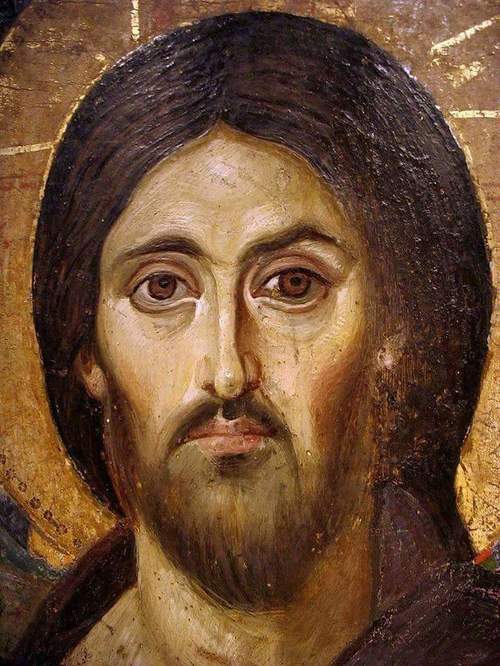
Part Ten
THE ‘I AMS’ OF JESUS
Series by Fr Gerasimos Koutsouras
St George Church, Rose Bay Sermons
Based on the book: The Great I Am’s of Jesus by Anthony Coniaris, Light and Life Pub. Co, 1969.
Sunday, 21st of April 2013
THE ‘I AMS’ OF JESUS
Series by Fr Gerasimos Koutsouras
St George Church, Rose Bay Sermons
Based on the book: The Great I Am’s of Jesus by Anthony Coniaris, Light and Life Pub. Co, 1969.
Sunday, 21st of April 2013
One of the most tender descriptions of God in the Bible was given by Jesus Christ when he said, “I am the good shepherd - Εγώ ειμί ο ποιμήν ο καλός” (John 10:14). In both the Old and New Testaments, the concept appears about eighty times. The shepherd’s life was difficult... but peaceful and simple. To be a shepherd in those days you needed to show tender loving care for your flock. You needed to feed them, water them, lead them out to graze, protect them against wild animals, protect them against harm, help them give birth, alleviate them of their wool in the warmer months. The relationship between shepherd and flock was mutually beneficial. Sheep are so placid, that they would have slim chance of survival in the wild.

In Eastern cultures, sheep were kept more for their wool and milk, rather than their meat. The shepherd’s family would only eat meat once a month or so. This meant that the shepherd got to know each sheep individually, over the ten or twelve year life-span. The shepherd knew which one was the child of which, he knew each one by name. Such was the appeal of the idea that the ancient Christians would draw and paint images of the shepherd in the underground catacombs of the first and second centuries as a way of depicting Christ without getting caught by the Roman authorities.


The prophet Isaiah describes God as a shepherd carrying his sheep in his arms:
“He shall feed his flock like a shepherd,
He shall gather the lambs in his arms,
and carry them in his embrace,
and shall gently lead those that are with young.”
(Isaiah 40:11)
David says in Psalm 95:7,
“For he is our God,
and we are the people of his pasture,
and the sheep of his hand.”
The Book of the Apocalypse describes Jesus Christ as the lamb of God and plays on the irony that the sacrificial lamb is also the shepherd. Chapter 7, verse 17 says,
In Eastern cultures, sheep were kept more for their wool and milk, rather than their meat. The shepherd’s family would only eat meat once a month or so. This meant that the shepherd got to know each sheep individually, over the ten or twelve year life-span. The shepherd knew which one was the child of which, he knew each one by name. Such was the appeal of the idea that the ancient Christians would draw and paint images of the shepherd in the underground catacombs of the first and second centuries as a way of depicting Christ without getting caught by the Roman authorities.
The prophet Isaiah describes God as a shepherd carrying his sheep in his arms:
“He shall feed his flock like a shepherd,
He shall gather the lambs in his arms,
and carry them in his embrace,
and shall gently lead those that are with young.”
(Isaiah 40:11)
David says in Psalm 95:7,
“For he is our God,
and we are the people of his pasture,
and the sheep of his hand.”
The Book of the Apocalypse describes Jesus Christ as the lamb of God and plays on the irony that the sacrificial lamb is also the shepherd. Chapter 7, verse 17 says,
“The lamb in the midst of the throne will be their shepherd,
and he will guide them to springs of living water;
and God will wipe away every tear from their eyes.”
Then there is the famous shepherd psalm, Psalm 23.
“The Lord is my shepherd,
and I shall lack nothing.
He shall lead me into green pasture.
He leads me beside calm waters, he restores my soul.
He guides me along paths of righteousness for his name’s sake.
Even though I walk in the midst of the shadow of death,
I will fear no harm, for you are with me
Your rod and your staff protect me.”

In the book of Ezekiel we have another picture of the shepherd. The Lord lashes out at the false shepherds, who had been feeding themselves, and not the flock.
“The weak you have not strengthened,
the sick you have not healed,
the crippled you have not bound up,
the strayed you have not brought back
the lost you have not sought,
and with force and harshness you have ruled them.”
(Ezekiel 34:1-10)
Then God utters a prophecy, “I myself will be the shepherd of my sheep.”
(Ezekiel 34:11-16)
As the good shepherd, Jesus was moved with compassion for people, and the Gospel describes the scene with the shepherd and sheep analogy. “When he saw the crowds, he had compassion for them, because they were harassed and helpless, like sheep without a shepherd.” (Matthew 9:36)
As the good shepherd, Jesus said to his disciples, “Fear not, little flock, for it is your Father’s good pleasure to give you the kingdom.” (Luke 12:32)
Brothers and sisters, we Christians became members of the flock of Christ - η ποίμνη του Χριστού when we were baptized. But we grow up sometimes not knowing where we are going, not knowing what the point is, not knowing right from wrong.
Jesus spoke of people losing their way in life as sheep getting lost. There is a story of a city man speaking with a farmer. “How do they, the sheep, get lost? asked the city dweller. The farmer responded, “They just nibble themselves lost. They keep their heads down, wander from one green tuft to another, come to a hole in the fence and never can find the hole by which to get back again.” This demonstrates that to the farmer, the reality is very matter-of-fact.

It is us modern people who get offended too easily when we hear that we may be compared to sheep. That is because all we know about sheep is that they follow each other. We have no clue about all the other aspects of the mutuality of shepherd and sheep. And even though we resist the Christian use of a simple analogy, we nevertheless carry on our lives as sheep anyway... following all the ‘-isms’ of this world, materialism, capitalism, socialism, feminism, rationalism... thus ironically proving the ‘lost sheep’ analogy as true. Then there is the ultimate ‘-ism’... the Greek word ploutismos (ploutos = wealth) means that everything in our life is geared towards the pursuit of wealth... to the detriment and at the expense of everything else... family, relationships, friendships, even our humanity. Thus it is, that the dominance of the wealthy over governments and their fellow human beings is called ‘plutocracy’.
It was no accident that when speaking about the dominance of money in our life, Jesus gave a polarised statement.
“You cannot serve two masters.
Either you will hate the one and love the other, or you will be devoted to the one and despise the other.
You cannot serve both God and Mammon”
[the pagan god of money]” (Matthew 6:24).
We Orthodox Christians, use a paradoxical term to describe the marriage between our personal freedom and our choice to follow and live the life in Christ. We say “λογικά πρόβατα - rational sheep”, which connotes that as rational human beings, we choose this way of life and we can leave whenever we want to. The rational refers to our freedom to choose this way of life and the sheep refers to how we understand our relationship with the Spirit of Life, Light and Love, otherwise known as God. For us, our way of life is not about the sheep... its about the shepherd. What a shepherd does for the sheep, Christ does for us - only infinitely better. He defends us. He feeds us, He guides us. He knows his sheep one by one... by name.
Jesus Christ said,
“I am the good shepherd. The good shepherd lays down his life for his sheep.” (John 10:11)
“There is no greater love than for someone to lay down their life for their friends.” (John 15:13)
Jesus Christ - our Good Shepherd - did just that for us.
Amen.
